 Five years have gone by since my brain injury. Five years. I’m more than a little amazed it has been that long. I mean, I know it has been that long, and I know I’ve been talking about it for the entire time. This journal is proof of that, if nothing else. The earliest entries chronicle the first few weeks and months after my emergence from the coma. I’ve tended to return to thinking about that injury around its anniversary. I don’t think that’s terribly unusual. I take stock of where I am today and try and compare to how I was feeling five years ago. And then there are the flights of fancy where I imagine some alternate timeline in which the injury never took place. I try to draw comparisons and form conclusions across that divide. As you might imagine, it doesn’t work out very well. My time traveling skills are fairly restricted. Fortunately that restriction keeps me more-or-less safe from paradox.
 For the past five years my friends and I have traveled to Las Vegas on the anniversary of my injury. We drink. We gamble. We eat too much. We stay up too late. Generally we leave our responsibilities at home and enjoy the moment. This year was no different in that respect. We did have a smaller group out of Chicago than in years past: T., Smokes, Stingo, Sabz, Bitsy, Whirl and I were joined by some special guests. Frank and Shane joined us from the City of Angels. Whirl’s cousin, Ani, was coincidentally in Las Vegas organizing a conference at the Mirage for her company. And Bitsy’s friend, Jeanine, who lives in Las Vegas, came down to the Strip to hang out with us for at least some of the time.
As for gambling, I scratched that itch with some healthy doses of pai gow poker, craps and limit hold ’em. The highlight of my gambling this trip was the five hour session at the Bellagio playing low stakes pai gow. The fact that at the end of the marathon I walked away from the table up nearly double what I wagered is just gravy. What made this such a fun experience were our two dealers, Reza and Jeff. Whirl, Smokes, T., Sabz and I commandeered a five seat pai gow bonus table. Normally pai gow poker seats six. This version we found at the Bellagio featured a community dragon hand played the house way, limiting the number of actual players to five maximum. Anyone playing could decide to bet on the communal dragon hand as well. This differs from how the dragon hand is offered and played normally. In a more typical version of pai gow the dragon hand is only offered when there is an empty seat at the table and the dragon hand is played with a rotating right of first refusal. The dealer offers the hand sequentially around the table. If you want to play it, you match your original bet and set the second hand any way you desire within the restrictions of the game. At our table, with a maximum of five players the dragon hand was always available. You just had to bet. And everyone that bet, was betting on the same hand against the house. It was a nice twist.
 I enjoy pai gow because it is such a social game. It plays slowly with a lot of pushes where neither the player nor the dealer win the hand. And players can help each other with strategy and advise on how to play. The actions of one player have no effect on the actions of other players. (This is true of many table games, but there are far too many perceptions and superstitions surrounding games like blackjack to act otherwise.) In pai gow you cannot “steal someone else’s ace”, for example. Whether this actually changes the probabilities or not is irrelevant. Perception and superstition are king and queen in gambling.
So. The five of us belly up to the table at the Bellagio and proceed to play and play and play. The afternoon starts slow, and we strike up a congenial conversation with our dealers. Over the course of the next five hours they would teach us strategies to pai gow, how to play banker and let us in on some of their collected stories in Las Vegas. Reza has been a dealer with MGM Mirage for twenty-two years. He’s dealt at the Golden Nugget, the Mirage and the Bellagio among others. Each time Steve Wynn would open a new casino, Reza would move to the new flagship. He amazed us with his ability to read seven card hands displayed for mere fractions of a second. MGM Mirage often deployed him to deal with high maintenance players. He would deal for 40 minute stretches and then take a 20 minute break. His relief was a phlegmatic dealer named Jeff. Jeff was the dealer who instructed Whirl and Smokes on the rewards and pitfalls of playing banker in pai gow and offered particular advice on just when to split pairs.
The two of them had plenty of stories of their experiences working as dealers at the Bellagio and elsewhere. They were always discreet, never compromising the identities of their customers or relating events that were particularly incriminating. Two of the most memorable stories concerned the particular characteristics of high rollers. One story detailed how the Bellagio appeased a particular baccarat player. The unnamed high roller could not suffer the clicking noise emitted when cards were pulled from the shoe. The Bellagio staff constructed a special shoe that did not click, and keeps it in storage just for this player. Another story was from some years ago at an unnamed casino when the largest chips on the floor were valued at $20000. A high roller was playing blackjack at $120000 a hand and had animatedly (and inadvertently) spilled the tray belonging to one of the cocktail waitresses. Drinks go everywhere. It’s a mess. The player brusquely asked the waitress what her mortgage was. She responded with the monthly payment value and was rejoined with: “No. That’s not what I asked. How much is your mortgage.” She thought for a moment and then told him it was $93000. The player immediately grabbed a stack of five of these $20000 chips and tips the waitress. This caused an uproar in the casino. The casino demanded that all markers be paid before tips were paid out. The casino refused to cash the waitress’ chips. The amount of money this player had dropped at the casino over the years was astronomical and eventually the casino saw reason and reached a passable resolution. The waitress ended up having to pay taxes on the tip, but she kept the money. The casino kept the player.
The recurring theme with these stories was that Las Vegas holds a magnifying glass to the the personalities that come there. People do not fundamentally change when they visit; instead the become that much more of who they are already. Kind people grow kinder; meanness becomes moreso. I appreciate this observation more and more as I think on it.
I coached Sabz and T. at craps, one of my other favorite games. Craps is the polar opposite of pai gow. Fast-paced, hectic action. Highly volatile, craps runs on streaks. I’m still not sure what that says about me that I count the slow-paced leisurely game of pai gow and the frenetic chaos of craps as two of my favorites.
 The third game I played for any significant length of time was Texas Hold ’em poker. I played in one tournament, and spent the rest of my time playing cash games. This year I avoided no-limit hold ’em and opted for the limit tables as a change of pace. I did well. Not “big money” well, but well enough that I could pay for dinner and a show with my winnings. A couple of notable moments came while playing at the Flamingo. Smokes and Whirl were playing on the table next to me. Smokes has a singular laugh. For those of us who know him, it’s a beacon. We can always find him anywhere in the casino. It cuts through the noise of the slot machines, the cheers of the craps tables and the clatter of the roulette wheel. My poker table noticed it as well. I explained to them that it belonged to my friend and when Smokes came over to talk to me later, I introduced him to his fan club. Smokes has a way of making friends wherever he goes. That’s one of the things I love about him.
The other poker story reminded me that there’s always someone playing an angle, even among the low-rollers like me. I’d been playing limit hold ’em for a few hours, mostly unsuccessfully. My head was still above water, but I wasn’t making much headway and was starting to consider going and doing something else. Getting schooled on the improper use of the term “set” for what is accurately described as “trips” hadn’t helped my self-esteem and likely had gotten my thoughts of departure started. A woman sat down and flashed her platinum players club card to the dealer. He read her name and keyed her into the table. As the dealer handed the players club card back, he asked if she was Vietnamese. She said she was and asked the dealer how he knew. He stated her last name, pronouncing it correctly: Nguyen. The player feigned shock. Shock at two things: one, the dealer had pronounced her name correctly; and two, that he had drawn the conclusion that it was a Vietnamese name. At this point our dealer, Rock, pointed out that Scotty Nguyen is one of the best-known professional poker players currently active: a five-time WSOP bracelet winner, including the 1998 main event. Scott Nguyen is also from Vietnam. While Ms. Ngyuen sat there shuffling stacks of 8-10 chips simultaneously in each hand and claiming complete ignorance, I quietly packed up and headed for places east. Of course she’d never heard of Scotty Nguyen. That’s just absurd. — Fool me once, shame on you. Fool me twice, shame on me.
 In years past our group has consisted of a number of friends who enjoy buffets. We’ve been to several of the top buffets in Las Vegas. But after a while, I have to admit that all buffets start to blend together and none of them leave me particularly satisfied. This year the vocal buffet-goers were unable to join us, and we set out on a new direction with food. Whirl enjoys breakfast and did some research on some of the best breakfasts in Las Vegas. She found it. One of the most incredible breakfast experiences I’ve ever had was the chicken and waffles at Hash House a Go-Go at Imperial Palace. Sage fried chicken stacked with bacon waffles, hot maple caramel reduction and crowned with fried leeks. Truly a breakfast of champions.
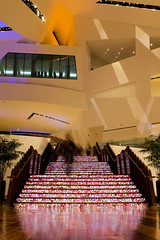 One of my other fascinations with Las Vegas — besides food and gambling — is how it continues to reinvent itself architecturally. In December 2009, several key elements of the huge CityCenter development officially opened. We were able to visit the Aria casino and the Crystals entertainment and retail complex. I attempted to photograph some of this development from various perspectives. I’m uncertain of my success. The project is immense, the largest privately funded construction project in the United States, costing over $11B. While touring the spaces and dodging a Porsche 997 GT3 and a Ferarri F430, I happened into the Dale Chihuly Gallery at Aria. Whirl reminded me several times this trip about how much I appreciate Dale Chihuly’s art. He is one of my favorite artists. He had pieces at the Museum of Science and Industry a few years ago as part of “The Glass Experience”. The 1997 documentary Inspirations takes a in-depth look at his particular creative process.
Like our experience at the Bellagio, the gallery was empty. I had the place to myself, having arrived just a couple hours before closing. I made the faux pas of asking the curator of the gallery, “Do you mind if I shoot?” “Shoot?” he repeated back to me skeptically, throwing a glance to the glass sculpture that surrounded us. “Yeah. Shoot,” I start, then pause and turn crimson. “With my camera,” I attempt to explain hastily, punctuating with very nervous laughter. Earlier in the evening, I’d been asked to move along by security in The Crystals while trying to shoot the Grand Staircase. The gallery curator was much more congenial and finally let me off the hook with a well-intended caution to consider a less alarming verb when talking about photography around glass. I couldn’t help but remember Sean Connery’s line in Hunting for Red October: “Most things in here do not react well to bullets.”
I stayed in the Chihuly gallery until closing. I spoke at length with the curators about the pieces — all of which are also for sale, if you’re interested. We also talked about “Fiori di Como” the 2000-piece installation that forms the ceiling of the Bellagio lobby. I learned that the glass weighs over 40000 pounds, with an additional 10000 pounds of steel armature to support it. It continues to amaze me how Las Vegas can make this sort of fantastic artwork available to be experienced. The next day I had a similar experience as I spent a few minutes talking to Jennifer, the curator of the Richard MacDonald gallery at the Bellagio. MacDonald’s sculpture is inspired by the human form and the broad range of human emotion. MacDonald had been commissioned by Cirque du Soleil founder Guy Laliberté to create several pieces inspired by the circus. I did not have my camera with me at the time, however some of the exhibit is available online.
As a cap to the trip, Whirl and I took in the Cirque du Soleil show Mystère at Treasure Island. I have seen several shows over the past years and this one was quite impressive. We both had a great time taking in some breathtaking performances.
So now I head back to the real world, refreshed, relaxed and inspired. After five years of hard-fought reflection, I suspect that’s exactly as it should be.
 I have been recommending
  No, I’m not talking about the Bruce Springsteen album — although I do have that album and have enjoyed it a great deal. The Boss doesn’t do zombies. And this is a zombie novel. Steamboat Wille lent it to me so if there is some reason I end up disliking the book, I can conveniently blame him and escape any sense of culpability. As an aside, after about fifty pages in, I am enjoying it, so I think he’s off the hook. The Rising is the first novel by Brian Keene. It won Keene a Bram Stoker Award in 2003. It’s the story of a zombie uprising, but an uprising unlike the more familiar George Romero fashion.
 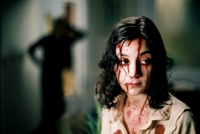 My friend L Cubed challenged me to put together a list of films for 2009. I took him up on the challenge. I don’t mean this to be my list of the best films of 2009. Rather it is a list of the films I quite enjoyed. I find myself talking about them and referring to them in subsequent conversation. They’re not necessarily even films that premiered in 2009. A number of these films were released last year, and one was released in 2004. These are films I saw this year. That’s my criteria for consideration: I saw the film in 2009, I enjoyed the film, I’ve talked about it with someone since viewing it.


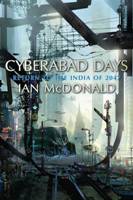
 I came late to reading Ian McDonald. A couple years ago I read the second of his recent popular science fiction novels, Brasyl. I skipped the book that appears to have put him on the map, River of Gods. I am trying to remember why I did that, and what occurs to me is that I couldn’t find River of Gods in the bookstore and Brasyl had just been released. So maybe I picked it up as a book of opportunity. I remember being underwhelmed by Brasyl. And while I appreciated what McDonald was trying to do, I never felt fully satisfied by the execution of it. It didn’t compel me. It didn’t pull me in to a world like I had expected it to do. At some fundamental level, it just didn’t seem to work.
 Beta|Erinyes