Archives For author

I’ve written some about my college education. I attended Wabash College from the fall of 1988 until I graduated in the spring of 1992 with a Bachelor’s of Arts degree in philosophy and German. Wabash College is a liberal arts college for men. Wabash’s curriculum is designed to impart general knowledge across a broad spectrum of topics. More importantly, the curriculum is designed to foster independent inquiry, critical thought, and clear expression both oral and written. To read purposefully, think critically, and write effectively.

I have relied on this educational foundation in everything I have accomplished since college. More than any particular formula, anecdote or algorithm these principles have served me well. I believe in the liberal arts and I defend them as a true and valued principle of higher education: increasingly necessary in a more complicated, connected world.

I came across Liz Coleman‘s recent TED Talk, “Liz Coleman’s call to reinvent liberal arts education” in the past week. Coleman presents a powerful dissection of the state of higher education and revival of the power and necessity of the liberal arts. I was overjoyed. Liz Coleman is the president of Bennington College. In the mid-1990s she deployed a radical plan to reinvent the college and the liberal arts the college entrusts.

The complaint: “Over the past century the expert has dethroned the educated generalist to become the sole model of intellectual accomplishment.”

A solution: Develop a framework of higher education as an active pursuit — a performing art for public good. Include rhetoric, design, meditation, improvisation, and quantitative reasoning alongside the canon of traditional topics. On technology she reminds us that we must acknowledge that the more powerful our reach of our voices the more important the question “About what?”

Specialization obfuscates problems. Specialization constructs a world of silos: people working alongside one another never fully realizing the interconnectedness of what each other does. Specialization creates a world of blinders, or worse yet a world of the blind leading the uninterested. To this end I found this statement one of Coleman’s most powerful:

“The most important discovery we made in our focus on public action was to appreciate that the hard choices are not between good and evil but between competing goods. This discovery is transforming. It undercuts self-righteousness, radically alters the tone and character of controversy, and enriches dramatically the possibility for finding common ground. Idolatry, zealotry, unsubstantiated opinions simply won’t do. This is a political education to be sure. But it is a politics of principle not of partisanship. [….] We the people have become inured to our own irrelevance when it comes to doing anything significant about anything that matters concerning governance, beyond waiting another four years. [….] The problem is there is no such thing as a viable democracy made up of experts, zealots, politicians and spectators.”

I am encouraged to hear such a powerful appreciation for the generalist, for the soundness of the liberal arts, updated with a call to public action. For too long our culture has turned introverted to the point of selfishness and conceded the spheres of philanthropy, charity and welfare to religion. And perhaps more importantly than concern for our fellow man, but the concession of even thinking about the larger interconnectedness of systems. Particularly as they impact concepts such as justice, equity and truth.

I came across Coleman’s talk just a day after reading the following line from F. Scott Fitzgerald‘s short story “Bernice Bobs Her Hair” and maybe a week before my own birthday. Birthday’s and New Years Day are two moments that bring out a particularly strong tendency toward introspection and self-evaluation: “At eighteen our convictions are hills from which we look; at forty-five they are caves in which we hide.”

The Apotheosis of WashingtonThis past week work sent me on a trip to Washington DC. I went to assist with the relocation of the news bureau and to there and to perform some network changes on Capitol Hill. I have not been back to Washington DC since I was a very small child. When I say very small, I mean two years old. My parents have pictures and stories of me visiting the various sights around the city. But my memories are much fuzzier. I think I remember it raining once. Maybe I was just crying. Who knows.

Anyway, so I flew into Dulles on Sunday night and met up with Jim at Union Station Monday morning. I went early to take a few pictures. I wasn’t sure how much time, if any, I was going to have to do anything remotely touristy, so I just packed a little camera for some snapshots. I must say Washington DC’s Union Station trumps Chicago’s Union Station by quite a margin. It’s an impressive piece of architecture and serves as a hub for by Amtrak, MARC and VRE commuter railroads, and the Washington Metro transit system. Chicago’s own architect Daniel Burnham designed the station in the Beaux-Arts style. It opened in 1908.

From there we hiked over to Capitol Hill and obtained visitor credentials for me. I gained access to the Senate Press Gallery workspace and telecommunications attic above. While we waited for the Senate IT personnel to arrive and escort us up to our equipment, Jim gave me a quick tour of the Capitol. Jim showed me the rotunda, Statuary Hall and the Old Supreme Court Chambers before we met up with the Senate technician. Our equipment is mounted in the attic above the press galleries. To get there we had to walk up a very narrow brick spiral staircase past the “Wall of Shame”. The righthand wall of the staircase is littered with grafitti of names and dates. In my quick trip by the oldest dates I saw were from 1936. Jim informed me later that the wall is named the way it is as you do not want to get caught writing on it: so of course lots of people try.

Union Station Colonnade We spent the rest of the day working on the logistics of the office move. Tuesday and Wednesday were much the same, moving back and forth between the old and the new offices and working out details. I had some specific technical things I needed to accomplish to get the network up and running in the new space. That went well and then I assisted Jim with the myriad little details that go into moving an office of this size and complexity. Long, hot days, with not much in the way of sightseeing breaks. We did take a few minutes to go up onto the roof of the old bureau and look out over the city Tuesday afternoon.

Washington has height restrictions on the buildings. There are no skyscrapers. Nothing can obstruct the view of the Capitol. The result is that there aren’t any buildings much over 10 stories. That gives the city a distinctive feel. A park can effectively wipe out the feeling that you’re in the middle of a city as the trees block the view of all the buildings. Nothing rises above them.

I had some delicious crabcakes — the signature DC dish. I drank a beer at the Post Pub across the street from the Washington Post. And I came to the conclusion that no one is actually from Washington DC. Everyone there is actually from somewhere else, often another continent.

All in all, it was a good trip. Hot and humid, couple of thunderstorms, lots of work. I got to see several of the people I worked with last summer during the political conventions and I got a brief glimpse of the nation’s capitol after thirty-plus years of being away.

Jazz Age Stories, F. Scott FitzgeraldMost people recognize F. Scott Fitzgerald as a novelist. I remember college professors promoting The Great Gatsby as the exemplar of “the great American novel”. And up until I discovered this collection, Jazz Age Stories, I had not given it much thought that Fitzgerald might have written short fiction as well. I was intrigued to learn that over the course of his writing career Fitzgerald made more money from the publications of his short stories than he ever did from his novels.

Jazz Age Stories is reprint of two earlier collections of short stories, originally published by Scribner’s: Flappers and Philosophers (1920) and Tales of the Jazz Age (1922). This republication collects all of the stories in those two earlier editions. Some notable stories include “The Ice Palace,” “The Curious Case of Benjamin Button,” “The Cut-Glass Bowl,” “Bernice Bobs Her Hair,” and “Diamonds as Big as the Ritz.”

I am curious to learn whether these shorter glimpses of the Jazz Age will show me something I did not see while reading Gatsby. Fitzgerald referred to the era in which he lived as “a generation grown up to find all Gods dead, all wars fought, all faiths in man shaken.” We have come to know this generation as the Lost Generation: John Steinbeck, Earnest Hemingway, Ezra Pound and F. Scott Fitzgerald. I have a strong affection for each of these authors — an affection with which my child bride does not always concur. This may be why I occasionally refer to her as Zelda.

The House on Mango Street, Sandra CisnerosThe Chicago Public Library’s Spring 2009 selection for One Book, One Chicago is The House on Mango Street by Sandra Cisneros. In 1982, Cisneros received a National Endowment for the Arts fellowship. She used the fellowship to travel to Europe and write about her childhood. She developed the book seemingly accidentally as a series of vignettes, “Fifty pages had been written but I still didn’t think of it as a novel. It was just a jar of buttons.” Poetry and narrative blend in the collection of little stories to create a vibrant picture of a rootless sense of home.

The back jacket cover reads:

Acclaimed by critics, beloved by readers of all ages, taught everywhere from grade schools to universities across the country, and translated all over the world, The House on Mango Street is the remarkable story of Esperanza Cordero. Told in a series of vignettes — sometimes heart-breaking, sometimes deeply joyous — it is the story of a young Latina girl growing up in Chicago, inventing for herself who and what she will become. Few other books in our time have touched so many readers.

2009 marks the 25th anniversary of the publication of The House on Mango Street.

Pay To Play, Elizabeth Brackett I feel I’ve been on a political roller-coaster this year in Illinois. I’m sure part of that has to do with my work at the political conventions last summer. Another factor you may have read about in the newspaper. And then there’s this story. The story about the Illinois governor arrested on on federal corruption charges last December. January 8th, the Illinois House of Representatives voted to impeach the Governor 114–1. The Illinois Senate subsequently convicted and removed from the Governor from office on January 29, 2009. The Illinois Senate’s vote was unanimous: 59–0. To add insult to injury, the Illinois Senate also unanimously voted to bar the now-former Governor from holding any public office in the state of Illinois. Ever.

All of this raises the question: How did we get here? Veteran Chicago journalist Elizabeth Brackett attempts to explain in her book Pay to Play.

From the back cover:

In Pay to Play, Elizabeth Brackett uncovers new details as she goes behind the story of the first governor to be impeached by the Illinois legislature. All the time tracing the background of corruption in Illinois politics and its implications for state government executive branches across the country, she tells precisely how Blagojevich’s personal biography and his political upbringing paved the way for his reckless fall; what the dilemma of selecting replacement senators means for other states; what secrets the federal trial of the governor is likely to produce; why Roland Burris was selected for the U.S. Senate seat for Illinois; and how a man named Obama could emerge with integrity from the swill of this same political environment.

I am continually on the lookout for ideas, techniques and approaches to push me, to challenge me to think about what I am doing with the camera — and perhaps more importantly why I am doing it. Here are three projects I have run across in the last month that have inspired me:

To Beantown and Back, Scott Strazzante, Chicago Tribune
For the first time since 1997, the Chicago Bulls and the Chicago Blackhawks are in the playoffs at the same time. On Saturday, Chicago Tribune photojournalist Scott Strazzante traveled from Chicago to Boston to cover the Bulls vs. Celtics in the the morning. He flew back to Chicago in the evening in time to cover the Blackhawks vs. Flames at the United Center. Two playoff games in two time zones, 20 hours of work, 7656 photos and two Chicago victories. The Chicago Tribune published the resulting photo essay as “To Beantown and Back” both online and in print.

I admire how Strazzante makes news gathering a human activity. He intersperses his photographs and captions with bits of audio to capture elements of the stories from the people around him. I thought the interviews with the various cab drivers were brilliant additions to the story — and the quick encounter with Cheryl Baker on the flight to Boston. By including these elements, Strazz reminds me that news — even traditional media news — is not constructed by faceless corporations but by people in the world. People who have their own personalities and quirks. He reminds us that the stories he tells are essentially human stories.

We’re All Gonna Die – 100 Meters of Existence, Simon Høgsberg
For twenty days in the summer of 2007, Danish photographer Simon Høgsberg photographed people from a railway bridge on Warschauer Straße in Berlin. He shot for two hours every day at the same time of day in order to get the same light for each photograph. He produced over 3000 portraits. In the end he selected and arranged 178 of these portraits into one long composite image entitled “We’re All Gonna Die – 100 Meters of Existence”.

In an interview about the piece Høgsberg states that, “[the title] is meant to point out that life is beautiful, and unless we open up to each other instead of keeping our longings, hopes and experiences to ourselves we’ll fall into the grave with a lot of valuable information and love that we never got around to sharing with the people we’re in touch with.”

What I like about this project is that it illustrates how advances in technology can enhance an artistic vision — rather than just giving us an excuse to do crazy things in Photoshop. I believe this project could be accomplished using traditional photographic techniques. It is just that the advances in photographic technologies — specifically digital photography — make this sort of project accessible. And not only accessible for the artist, but for the audience as well. Digital creation makes the composition of the piece obtainable. Digital distribution of the piece makes it accessible to wider audience than ever before.

A Wolf Loves Pork, Takeuchi Taijin
This year a lot has been said and written about the convergence of still photography and videography. Camera manufacturers have begun to seriously incorporate the features of both forms of visual arts into their product offerings. Japanese artist Takeuchi Taijin has taken a different approach on this issue of convergence with “A Wolf Loves Pork”.

Using 1300 still photography prints, Takeuchi Taijin connects the pictures with each other and the world of his apartment to tell an exceedingly clever story in stop-motion animation format. The resulting film transcends both media types — impossible without the inclusion of creative still photography within a video framework. Moreover the videography framework as stop motion itself refers back to the original roots of still photography.

Grr! Argh!I had an engaging conversation today about the rapid adoption of social media phenoms: Facebook and Twitter. This was more than just a discussion of the fantastic rates of adoption these two sites have enjoyed. We talked at length about their ubiquity and utility. As more and more people I know have begun using these services, I have come under increasing pressure to join them. I haven’t. That may sound egotistical or misanthropic — a tried and true (and tired) way to reassert my “dark and mysterious” demeanor in an increasingly over-exposed world.

I don’t mean it that way.

I have a long history of adopting technology ahead of the curve. And again this may sound like bragging or elitism. My way of saying that I was country before country was cool. Fine. What I’m trying to explain is my methodology for adoption of new technology. I’m not a technological explorer — tinkering with new technologies just for the sake of discovery. I want to have a purpose in mind. I separate art from craft, poiesis from techne. My primary criteria for this separation is utility. Technology serves a purpose. It has a function. It does something. When a given technology proves that its utility exceeds its cost, I adopt it.

I see Twitter as another communication model, the latest of many that have followed since the model for a computer has shifted from a computing device to a communication device. Mobile computing has accelerated this transition dramatically. But absent a compelling reason to use this tool to communicate over any of the other well-established ones I already enjoy, Twitter is an empty vessel, lacking real utilitarian value.

I find Facebook an empty activity in its own right — sociological navel-gazing at best. A pass-time on par with a Saturday afternoon filled with John Woo movies or an MTV marathon of “The Real World.” At worst it is an unfortunate reconnection with a past that by all rights I buried in the past.

Facebook is the Sims but with real people.

So far I have not seen the compelling use-case argument for either of these media. Spreadsheets, email, wikis, digital photography: these passed my arbitrary utility test with ease. Blogs, instant messaging, and cellular phones had a more arduous time of convincing me. MySpace, Facebook and Twitter remind me that I am rapidly becoming a middle-aged member of Generation X. I was born into the Space Age, not the Internet Age. In terms of the Internet culture, I am Issei, rather than Nisei.

And I am in awe at how radically the society changes with such generational influence.

Smokes found this 2008 TED Talk by Jill Bolte Taylor and pointed it out to me. I was hooked immediately. In her talk Taylor takes us through the dramatic self-analysis of a massive stroke she suffered in 1996 and shares insights about the nature of perception, personality and creativity. What makes this talk interesting to a general audience is that Taylor is a neuroanatomist — a brain scientist. The stroke provided her with an opportunity that few people come across — and perhaps even fewer would desire. Taylor has made the most of the opportunity, rejoining:

“How many brain scientists have been able to study the brain from the inside out? I’ve gotten as much out of this experience of losing my left mind as I have in my entire academic career.”

What make this talk interesting to me as a specific audience are the similarities between her experiences with her stroke and my experiences with my own brain trauma. Four years ago nearly to the day I underwent a second brain surgery to clear a large blood clot and relieve fluid pressure on my left frontal lobe. It was an illuminating event for me that sparked my own slow return to something resembling normal. It also awakened a latent interest into brain function. This blog’s first major purpose was to chronicle my experience and recovery and from time to time I have gone back and re-read some of those rough initial posts from 2005 and sought out new insights into what transpired. I don’t mean to equate my trauma as identical to Taylor’s, but to draw a loose line of similarity between these life-changing events and underline the complexity of brain function and neuroscience with a personal perspective.

The chance for Taylor present her talk at TED is huge. I highly recommend the 2007 documentary The Future We Will Create for a look inside this annual conference and its mission to illuminate “ideas worth spreading”. The documentary is available as DVD and live streaming through Netflix.

She concludes her talk with a challenge to the preconceptions of personality and creativity. She challenges the audience to choose to live inside the creative power of our minds:

Which do you choose? And when? I believe that the more time we spend choosing to run the deep inner-peace circuitry of our right hemispheres the more peace we will project into the world and the more peaceful our world will be. And I thought that was an idea worth spreading.

McCarthy's Bar, Pete McCarthyIn 1998, Pete McCarthy embarked on a project to explore Ireland. Over the next six months he traveled from Cork in the south south up the west coast to Donegal in the north, always observing the Eighth Rule of Travel: “Never Pass a Bar That Has Your Name on It”. The result is McCarthy’s Bar. Publishers Weekly and Library Journal both compare McCarthy’s writing to that of Bill Bryson as he narrates the stories of his travels through the particular magic of Ireland.
I often find myself reaching for Irish tales in the late weeks of February and early March. Either that or baseball. I stumbled across this choice while browsing the local bookstore last week. Pete McCarthy was born in England to and Irish mother and an English father. He is at once an insider and an outsider to Ireland and it is that particular perspective that colors his tales, be they with the curious, the belligerent, or the infamous.

Along the way, McCarthy shows us that “In Ireland, the unexpected happens more than you expect.”

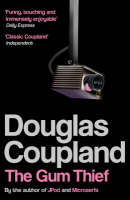
The Gum Thief, Douglas CouplandDouglas Coupland has written an epistolary novel. The Gum Thief is described as Clerks meets Who’s Afraid of Virginia Woolf? And quite candidly, that makes three things that I really like all wrapped up in one book. Roger and Bethany are the two main characters in the The Gum Thief, and Glove Pond is the novel within the novel– written by Roger. Roger is a middle-aged alcoholic contending with the fallout from an ugly divorce and loss of access to his child. Bethany is a younger goth girl without much direction other than black lipstick. They both work at Staples. Glove Pond is a corruption of Edward Albee’s play, Who’s Afraid of Virginia Woolf? At one point Roger writes that Glove Pond was supposed to contain characters like Elizabeth Taylor and Richard Burton — drunk movie stars who engage in witty repartee. Roger’s novel goes horribly wrong somewhere around the second paragraph.

Crush Inc. out of Toronto produced some fascinating video clips to advertise the The Gum Thief.

I’ve been reading Douglas Coupland novels since college when I discovered and fell in love with his first one, Generation X. Coupland has always been uncomfortable with the title of spokesman for this non-Generation. In a 1995 interview he went so far to state that the idea was dead following Kurt Cobain‘s suicide. And he moved on, writing about the emerging digital age. What attracts me about Coupland is his skill at finding nascent cultural events and chronicling them inside the structure of a story with authenticity. Like no other author, he can make me think that I am in the story– or at least in the area of the story looking on. There is a level of unabashed reality mixed with privacy in his writing.