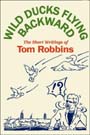
 Wild Ducks Flying Backward is Tom Robbins’ latest book. This anthology contains short stories and poems, reviews and essays written throughout Robbins’ career. Some of the material in this collection appeared previously in publications ranging from Esquire to Harper’s to Playboy to the New York Times. His introduction is a story in itself, describing the anticipation and culmination of opening your new Tom Robbins’ book for the first time. He describes the steps necessary to ensure privacy for this intimate encounter: finding the proper climate, the proper space and reminding us that “every halfway serious reader is perpetually subject to a form of coitus interruptus.” Those issues addressed, he continues to the heart of the matter:
Okay. At last you’re set. You prop up your feet (we should always read with our feet up, even on the subway or a bus) and retrieve the book, feeling in your hands the weight, the newness, the bookness of it. For a brief second you close your eyes, sip your libation, and allow yourself to wonder what Robbins is up to this time around. What strange lights on what distant mountainside have attracted his focus? Over whose campfire– gypsy? guerrilla? Girl Scout? shaman?– has he been toasting his ideas, his images, his figures of speech?
Curiosity suitably aroused, anticipation at a delicious pitch, you take a small breath and open the book and … Whoa! Wait a damn minute. Hold on. This isn’t the new Tom Robbins novel. Oh, it’s by Robbins alright, but … You look again at the cover. The Short Writings of … It’s printed right here on the jacket. Maybe it could have been in bigger type, but it isn’t as if you’ve been tricked. It’s your own fault and you should have paid closer attention. This will teach you to dash into a bookshop on your lunch hour. Wild Ducks Flying Backward is not a novel at all.
I have loved Tom Robbins’ work for over two decades when I first read Even Cowgirls Get the Blues. I fashioned my online nickname as a reverent reference to the mysterious man with a helmet of swarming bees in Robbins’ novel, Jitterbug Perfume. Robbins’ deteriorating eyesight reminds me just how great a treasure each new book, each new story must be.


 In 1940, Robert Heinlein wrote the story “The Roads Must Roll”. The rolling roads in the title were high-speed conveyors that connected cities. They carried people, freight and even restaurants and bars along for the ride. The express lanes of these roads had a top speed of 100 miles per hour. It is now sixty-seven years later and the best we can do to approach this idea are the moving walkways of Helmut Jahn‘s Concourse 1 out at O’Hare. That’s damned disappointing, right there. Don’t even get me started on the promises of flying cars, underwater resorts, moon colonies, and X-Ray glasses. And, hey! Where is my jetpack!?
 The Chicago Public Library picked The Crucible as the Fall 2007 selection for
  At the turn of the 20th Century, the sisters Ada and Minna Everleigh ran one of the most upscale brothels in Chicago: the Everleigh Club. The house, decorated with perfumed fountains, mirrored ceilings and a $15,000 gold-leafed piano in the Music Room, stood at 2131-2133 South Dearborn Street, not far from where Whirl and I now live. Custom House Row and the Levee District– as our neighborhoods were known at the time– were lousy with brothels and gambling halls, drifters, grifters and tramps.
 The short biography of Richard Bachman— written in 1984– states, “Bachman was a fairly unpleasant fellow who was born in New York and spent about ten years in the merchant marine after four years in the Coast Guard. He ultimately settled in rural central New Hampshire, where he wrote at night and tended to his medium-sized dairy farm during the day. [He and his wife, Claudia,] had one child, a boy, who died in an unfortunate accident at the age of six (he fell through a well cover and drowned). Three years ago a brain tumor was discovered near the base of Bachman’s brain; tricky surgery removed it.” Bachman died suddenly in February of 1985. He was killed by the Bangor Daily News when that paper published a story that Richard Bachman was actually Stephen King. King confirmed the story immediately.
 A little more than I year ago I finally read the Erik Larson blockbuster thriller, The Devil in the White City. I thoroughly enjoyed that book for a number of reasons: the book was factual, with hundreds of sources cited; it was set in nineteenth century America, a time and place with which I am repeatedly fascinated; it chronicled the 1893 Columbian Exposition that arguably brought Chicago back from the fire; and it illuminated– in great detail– the actions of one of America’s very first known serial killers.
 In 2005, TIME magazine chose On the Road by Jack Kerouac as one of the 100 best English-language novels from 1923 to then. This largely autobiographical work is based on the spontaneous road trips of Kerouac and his friends across mid-century America. Many consider this book the definitive work of the postwar Beat Generation– inspired by jazz, poetry, and drugs. I have never read it. I picked it up on my last trip to the bookstore, shortly before my trip to Pittsburgh. In college I read Blue Highways by William Least Heat-Moon while backpacking through Europe. Before that I read John Steinbeck’s Travels With Charley on a family road trip. I like to read travel journals while traveling. This time I just got distracted by something shiny– namely a certain wizard.
 Chuck Klosterman has created a collection of previously published essays as Chuck Klosterman IV: A Decade of Curious People and Dangerous Ideas. The title is a tribute to Led Zeppelin’s untitled fourth album– commonly known as Led Zeppelin IV. He breaks the volume up into three sections: Things That Are True, Things That Might Be True, and Something That Isn’t True. Publishers Weekly describes his work, “Whether investigating Latino fans of British pop icon Morrissey, interviewing female tribute bands like Lez Zeppelin and AC/DShe or eating nothing but Chicken McNuggets for a week, Klosterman is always entertaining and often insightful.” My friend Smokes turned me on to Klosterman with Sex, Drugs and Cocoa Puffs. I liked most of that volume and I’ve been looking out for his name from time to time, now. I ran across a couple of his articles in Esquire magazine: “
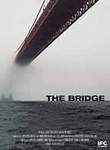 I have been anticipating the availability of this film on DVD since I first learned of it last year. The Bridge is a documentary film about suicide. Inspired by Tad Friend’s article “
 Beta|Erinyes