Archives For author

I am a strong proponent of minimalism. Particularly when it comes to web design. If you asked me, I’d be hard-pressed to come up with compelling aesthetic arguments as to why I prefer minimalist design. I just do. I like the absence of clutter. Minimalism done right gives me just the information that I want and nothing more. And that’s very different from giving me just the information I asked for and nothing more. Computer systems are quite adept at that second request. But as with many things, when making requests of computer systems often I ask the wrong questions. The computer is glad to give me what I asked for but not necessarily what I wanted. I believe good design should employ the art of intuitive anticipation along with the removal of distractions: potential, actual or hypothetical.

So it was with these ideas in my head that I set about looking for a new theme for our blog. Yes, this very blog you are currently reading. (Thank you for that, by the way.) When I decided upon the Wu Wei theme by Jeff Ngan and began showing it to my friends, I got several comments about how I was in love with minimalism. And while I don’t believe I am a particularly vocal evangelist of minimalism, I do recognize my own predisposition toward its use. And in those moments that I work on my own ideas of design, it comes out. I like the Helvetica font. My computers all have plain black backgrounds, without images or ornamentation. I try to think about minimizing clutter, and a consistency of look and feel. As I said, I hadn’t vocalized this in any particularly concrete way. It was just a set of preferences I had arrived at over time. So when the responses came to me, reminding me externally of a conversation I had only sporadically had with myself internally, I rejoined.

Yes! More minimalism!

And then I was immediately struck by the humor of such a statement. Minimalism, this movement in visual design where the work is stripped down to its most fundamental features. And I wanted more of it. Smokes suggested that it would make a great slogan for a t-shirt: make the word “more” really small, and the word “minimalism” really big. You can never get too much irony, right?

I sat on the idea for a few days, and then decided to give it a try. This morning I got out a piece of paper and a pencil, sketched a few ideas and then fired up Photoshop. Pretty soon, Smokes and I were exchanging ideas and I kept making new iterations on the design. Again, this was more of a learning exercise in trying to get my mind around Photoshop CS5 than an attempt at a career change. So without further ado, I present my iterations of “More Minimalism”.

Opinions welcome in the comments.

Read the rest of this entry »

Yesterday's NewsOver three years have passed since I left Midway Games for a position at the Chicago Tribune. A lot has happened in that period of time.

The newspaper’s parent company, Tribune Company was purchased and taken private. The new management reorganized all of the various IT departments into a central service division, Tribune Technology, beneath the Tribune Company corporate umbrella. This reorganization affected my position with the newspaper.

On December 8th, 2008, less than a year after the going private transaction, Tribune Company filed for Chapter 11 bankruptcy protection, citing a precipitous decline in advertising revenue and a credit market frozen by the housing bubble. Tribune has been in bankruptcy proceedings ever since.

As a result of investigations relating to the bankruptcy filing, independent examiners have stated they believe it is at least “somewhat likely” that the entire proceeding — from the levereged buyout to the bankruptcy protection — was fraudulent from the beginning.

In December of 2009, Sam Zell resigned as CEO but remained on as Chairman of the Board. Randy Michaels took over as CEO. This was the second promotion for Michaels within 18 months. A colony of other executives from Clear Channel joined Michaels to operate various aspects of Tribune’s businesses. Of these assorted personnel changes, the hiring of Steve Gable as Chief Technology Officer had the greatest direct effect on my day-to-day job within the company. I reported to four managers between September 2008 and December 2009. This frenetic guidance and direction — filtered through the various levels of management — set the tone for my workday: a race condition like no other I had experienced before.

Volatility became my watchword. Things changed. And things changed very quickly. One of my colleagues described the feeling as being like “working for a 143 year-old startup.” During my tenure, I participated in some incredible projects. I was tapped to be the networking support for our editorial coverage of both the DNC and RNC 2008 political conventions. I was part of a team that built a brand new national wide-area network, and the technical lead to build a brand new datacenter. Both the second and third project involved new technology, new challenges, strict budgets, and tight deadlines. I learned an incredible amount. I had the opportunity to work with some of the brightest, kindest, and most interesting people in my career.

All of this is a rather long prelude to what I’m wanting to say. So I suppose I should stop dissembling and get to the point. (During my time in the newspaper business I have learned how to bury the lede.) At the end of July I tendered my resignation with Tribune and accepted a position with the National Opinion Research Center. Established in 1941, NORC is a not-for-profit social science research organization associated with the University of Chicago. Clients include the the Bureau of Labor Statistics, the Centers for Disease Control, CNN, the Department of Defense, the New York Times, the US Department of Labor and the Wall Street Journal.

I was not actively looking for another position. In spite of how it may have sounded, given all the instability with Tribune I summarized earlier, I was not looking to leave. I liked my job there. As I said, I worked with great people. I liked what I was doing. I learned. I grew. The position with NORC was an opportunity in the most literal sense of the term: a favorable juncture of circumstances. They do not come often. I took it.

My particular projects and tasks at NORC are quite similar to those I had at Tribune, but the business is quite different. And it is my sincere hope that in making this shift I have exchanged volatility for stability without sacrificing personal growth and further opportunity. I don’t think I have.

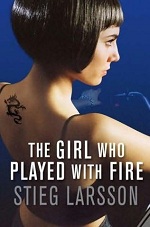
The second component of my birthday present from Mooch and Sarah was the second installment of the Millennium Trilogy by Swedish writer Stieg Larsson. The Girl Who Played with Fire picks up right where The Girl with the Dragon Tattoo left off returning to the complicated lives of Lisbeth Salander and Michael Blomkvist.

Whirl and I watched the Swedish film adaptation of The Girl with the Dragon Tattoo two nights ago. And without going into a protracted screed about the risks of adapting complex literary stories to film, both of us were somewhat disappointed by the adjustments made from the source material for the sake of transfer to the screen. Several of the double-binds, the psychological catch-22s, and character flaws were stripped away leaving a much more pedestrian story as a result.

So it is with that in the back of my mind, that I’m starting into the second novel, unencumbered by the specific demands of film. The Girl Who Played with Fire focuses upon “All the Evil” Salander referenced obliquely when working with Blomkvist on the Harriet Vanger disappearance. Larsson laid a great deal of groundwork here — mostly through Salander’s refusal to discuss anything about herself or her past.

The main plot of The Girl Who Played with Fire begins when a freelance journalist, approaches Blomkvist with plans to publish a story that exposes people in high office involved in Sweden’s sex trafficking business. Svensson’s story is based on research conducted by his girlfriend, a criminologist and gender studies scholar. When the couple are shot to death in their Stockholm apartment, Salander must talk. But as I learned in the first novel, Salander prefers to talk not with words, but action. Decisive, vengeful action.

For my birthday Mooch and Sarah gifted me with the very last copy of The Girl With the Dragon Tattoo left in Chicago. All other copies have been sold, borrowed or stolen to accompany summer vacationers, weary business travelers and college students returning for the fall semester. It seems like I must be the last man standing who has not read this book. I am exaggerating a little bit about receiving the last copy in Chicago. I am not exaggerating about the widespread interest this book has generated or how frequently I have encountered people reading it — particularly travelers. On my last trip to Los Angeles, I counted over thirty copies on board the plane. And I was flying Southwest. There are only 137 passenger seats on each of their planes. Almost one passenger in four was reading this book.

After retrieving the book from Whirl — who decided it was her prerogative to read my birthday present before I did — I’ve now joined the rest of the world in consuming this posthumously-published millennium trilogy of novels by Stieg Larsson. I do not often read crime novels. I think the last ones I may have read were a couple of Joe Kurtz novels from Dan Simmons. I’m only a handful of pages in as I write this and I’m already hooked.

Robert Dessaix of the Sydney Morning Herald described the story this way:

“An epic tale of serial murder and corporate trickery spanning several continents, the novel takes in complicated international financial fraud and the buried evil past of a wealthy Swedish industrial family.”

FistbumpIn my ongoing attempt to learn more about photography and try new things, Smokes and I set about to try our hand at an action-figure photo shoot. We collected some action figures, some poster paper stock and set up a little studio on our dining room table at the Warehouse. There’s an actual professional photo studio in the first floor of the building and while I considered asking if we could use it for our little project, I decided against it and went for a more DIY approach.

The result is a set of macro photographs of action figures is primarily a series of lighting experiments, humorous expressions and other whimsies and mistakes.

I don’t have a lot of lighting equipment (yet!). Just the camera, a tripod and a Canon Speedlite. I’d received an off-shoe bracket as a birthday present about a year ago. So I decided to use a birthday gift certificate pick up the requisite off-camera shoe cord (thanks Dugie!) so I could finally use the bracket for the shoot. We didn’t have umbrellas or remote triggers. And our key light could only be a could only be a foot or so away from the camera due to the length of the cord. That was our setup. It was enough variables for us to play with. We played with reflecting bounce flash light to backfill and minimize shadows. We used some of scientific equipment Whirl has collected over the years as props. We even deployed a flashlight as a spot to light up the plastic flame of the Green Goblin’s pumpkin bomb.

Doomed!Of course, the idea of two grown men — now in their 40s — playing with action figures is something that is going to engender some amount of scorn and ridicule. We knew that. We welcomed that. We were not disappointed. Bitsy and Whirl were quick to jump in and start things off with offers to provide appropriate snacks: celery sticks with peanut butter, Fruit Roll-Ups, and grilled cheese sandwiches with tomato soup. Tea made sure we had plenty of Capri Sun juice pouches.

So it was with the cynicism of our generation that we set about our shoot, finding humor and irony in the mudane. Ideas included:

  • Iron Man and Colossus embracing in reaction to the overturning of California’s Proposition 8
  • Green Goblin adding pumpkin spice to his homebrew beer wort
  • R2-D2 and C-3PO relaxing to some Daft Punk

The highlight photograph came at the end of the second day when Smokes came up with the idea of recreating the look of the conspicuous awkward prom photographs from high school.

See “Green Goblin and Spider-Man Go to Prom” after the break.

Read the rest of this entry »

"Hoisting the Cup" at the Blackhawks ConventionThis morning Farmboy and Princess stopped by our house. This wasn’t a surprise. I knew they were coming. They were headed down to the Blackhawks Convention at the Hilton just a couple blocks away. Farmboy had asked me a few months ago if I wanted him to try and get some signatures on my Seabrook sweater. That was the ostensible reason for the two of them stopping by this morning.

They lied.

They had more insidious plans. They kidnapped me. Press-ganged me. Shanghaied me. I was snatched. Waylaid. Spirited away!

I walk downstairs to give them the sweater and before I knew it the three of us were off to the Convention. I’d left my wallet, my keys, my phone. Everything was upstairs.

And none of that mattered. Spontaneity and the excitement to see the players, trophies and fellow hockey fans carried me over to the hotel. For my efforts I got (another) quick peek at the Stanley Cup, was able to see all of the NHL trophies, chatted up Frank Pellico and had my sweater autographed by Seabrook’s linemate, Duncan Keith.

Spontaneous Saturdays are good Saturdays.

Dragonfly Macro I celebrated my fortieth birthday with my family in Door County today. I am resisting the temptation to scribe something particularly moving or insightful about this event. I might attempt to develop a full rhetoric in defense of eudaimonia. However, Aristotle has already expertly articulated the ethics of a life in pursuit of happiness. I won’t expand upon his treatment except to comment on the soundness of his guidance and remark on my renewed agreement with the path. Aristotle argues for a definition of happiness as active virtue in concert with reason: living and doing well. Happiness is not a passive state; it is an active pursuit. A goal to strive for, rather than a reward to passively receive. This approach is the correct one. And this approach results in a life of choice continually made.

In a related but perhaps more culturally relevant reference to this choice — or at least a reference to a piece of work from this decade and not two millennium ago — I’ve had the song “Times Like These” by the Foo Fighters in my mind over the last several days. This stanza, a reference to the Hüsker Dü album New Day Rising, particularly resonates with me on this day.

I am a new day rising.
I’m a brand new sky
To hang the stars upon tonight.

(Nuccio DiNuzzo/Chicago Tribune)


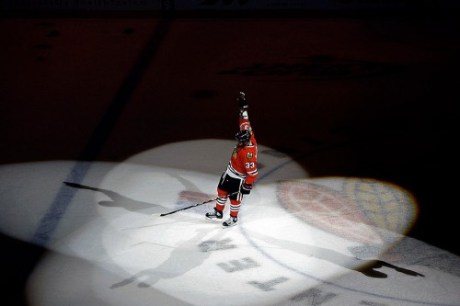
Patrick Kane fires a shot so fast that neither Whirl nor I nor the announcers nor Michael Leighton nor most anyone watching see the puck go in the net. The lamp doesn’t light. The bench doesn’t clear. Wachovia Center falls quiet. For several heartbeats everything is eerily still. Four minutes, six seconds into overtime and I hold my breath. Did it go in? Kane is cheering. Sticks are flying. Did it go in? Gloves are strewn all over the ice. Did it go in? The Blackhawks bench finally does clear. Did it go in!?

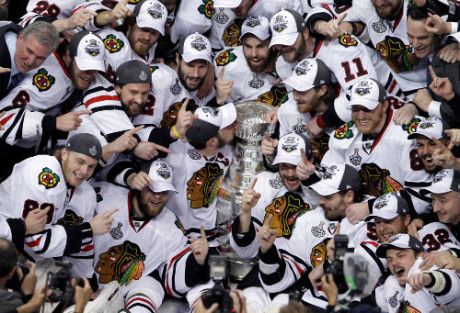
It did! It went in! Video review confirms what Patrick Kane already knew. Kane fired the puck beneath Leighton’s legs and wedged it underneath the padding at the back of the net. Game over: Blackhawks win 4-3! Series over: Blackhawks win 4-2! After 49 years the Blackhawks have brought the Stanley Cup back to Chicago.

I watched most of this season’s regular season games on television. And with a huge thanks to my friend, Farmboy, I was able to attend several playoff games at the United Center, both last year and this year. And it’s become something of a tradition for me to lose things at Blackhawks games. Watch, wallet, phone– voice. These have all been sacrifices of one sort or another I’ve had to make while attending. I am sorry for none of it.

I watched many of last three seasons’ regular season games since they’ve been broadcast on television– a fantastic development accompanying the changing of the guard from Bill Wirtz to his son Rocky. Before 2007 it was nearly impossible to watch the Blackhawks on television. If you wanted to see them play, you had to see them live. And I did that — not as often as I would go to see White Sox baseball. But certainly more often than I would see basketball or football. Hockey — for me — has mostly been constrained to a couple of weeks every four years when the Winter Olympics provide an opportunity to watch hours upon hours of the sport on television. So that’s what I did. I’d record hockey whenever the games aired and watch them whenever I had the chance.

I wanted to play hockey very badly when I was a kid, but my parents wouldn’t allow it. Given my tendency to find creative ways to injure myself, this may just have been a very wise decision. The father of one of my childhood friends took my to my first hockey game and taught me how to skate. I ended up helping to put together a broomball team with my friends when I was in high school. But broomball is not hockey.

It has been incredible to see the resurgence of interest in the sport in Chicago. There is an incredible amount of complexity and tradition in the game. I’ve enjoyed every minute I’ve been able to be a part of that: talking strategy and history with Smokes and Farmboy and Stingo. Yelling at the top of my lungs. Farmboy remarked to me in early 2008 that hockey never really left Chicago, but it sure is back!

Kiss the Cup!

(Scott Strazzante/Chicago Tribune)

Dustin Byfuglien broke out last night. In a big way. That fits. He’s a big guy. He grabbed two goals and two assists on the Blackhawks route to a 7-4 win over the Flyers in Game Five. Game Six is in Philadelphia on Wednesday night. Game Seven (if there is a need for Game Seven) would be back in Chicago on Friday night. Chicago has two chances to win one game. One goal.

That description came eerily close to the summary I had written in my head for Game Five when I was thinking about it the day before. You know, the game where I faced off against a bar full of Flyers fans elsewhere in downtown LA? On Saturday morning after that more miserable turnout with Game Four, I put my campaign into action. I was going to watch the Blackhawks win Game Five. I was not to be denied by the seemingly insurmountable sea of Great Unwashed LA Lakers fans, or Philadelphia, or anything else for that matter. They may have been conspiring against me, threatening to thwart my desire to watch Game Five of the Stanley Cup Finals. They would lose.

And they did lose. They lost well.

Like the Flyers, the Lakers and their fans were defeated. Now I can’t take credit for Ray Allen’s record-breaking eight threes that helped propel the Celtics past the Lakers 103-94 in Game Two. But what I can take credit for is orchestrating unbridled control of the best television in the hotel bar and refusing to relinquish it until after the final whistle. NBC broadcast Game 5 of the Stanley Cup Finals at 5:00 Pacific. ABC broadcast Game 2 of the NBA Finals at 5:00 Pacific. I got to the bar at 4:00 Pacific. This after a two-day effort with the Front Desk to ensure that they would show the hockey game at all. I befriended the bartender. I bonded with him about Chicago. I impressed him when I spontaneously changed into my Brent Seabrook sweater and camped out in front of the “good TV”. And I tipped him. I tipped him well. — For my efforts he gave me the bar’s only remote control for the night. I never gave it up. It was mine. That TV was mine. After the first period I got an assist from the bartender when patrons asked him despondently, “When do you think he’ll be done watching that hockey game?” — “When it’s over. When are you gonna be done watching that basketball game?”

I cheered my team in full confidence of what I’d done while the basketball fans groused and grumbled and had to settle for seconds. Or go elsewhere. I played like Byfuglien. I got to the front of the net, I got in my opponents face and when the opportunity came to score: I did.

It was heaven. — Just one more.

They seek him here, they seek him there,
His clothes are loud, but never square.
It will make or break him so he’s got to buy the best,
Cause he’s a dedicated follower of fashion.

For the second day in a row I’ve had some time to get out and explore this little corner of the City of Angels. Up until today, I’ve spent most of my exploration opportunities in Little Tokyo just to the southwest of me. My last trip out I made an evening’s photowalk on Bunker Hill for a couple hours. But beyond that I’ve pretty much contained myself to Little Tokyo and a couple blocks into the Old Historic Downtown area.

Today I decided to venture further on foot and made my way down Los Angeles Street through the Fashion District. I should have brought my camera with me; I didn’t think to grab it. I’d intended just to go out and find a cafe to get some breakfast and read my book. But I can, at times, become easily distracted and the blocks and blocks of storefronts beckoned me to come explore. So the camera lingered behind at the hotel and I ventured in.

I started the morning at the Lost Souls Cafe. This small cafe tucked back inside an alleyway off 4th Street reminded me a great deal of a couple of my favorite cafes in Chicago: the old Gourmand of Printer’s Row, now closed; and the No Exit Cafe in Roger’s Park. I understand that this place often has live music and sometimes serves as a gallery for local artists working out of the converted lofts in the historic district. This sleepy Sunday morning there were just a handful of people there enjoying a cup of coffee, reading the newspaper or video-chatting on their MacBooks. It’s a rough open-loft space with the mechanical infrastructure of the building exposed: duct work, fire sprinkler systems. Breakfast was nothing particularly spectacular, but certainly sufficient. The coffee was excellent. — I spoke with a couple of patrons who had ordered this big purple milkshake looking drink and learned that was also a house specialty. The Ube shake composed of yams, ice cream and milk and topped with a big dollop of whipped cream. Apparently they’re quite delicious. I may just have to go back and try one before I leave.

I stayed for a while and read my book while sipping my coffee. When finished, I headed out into the warm afternoon with no particular destination in mind. I turned right onto Los Angeles Street and started heading southeast. Soon I was swallowed up in the Fashion District proper. I’m trying to come up with ways of describing this area. The sidewalks are lined with narrow storefronts selling all kinds of suits, handbags, perfume, lingerie and accessories. For blocks and blocks. I just kept walking, guessing what might be in the next shop. I saw suits of every color and design: leather, suede, pinstripe, seersucker, denim. Italian suits with shiny threads. Heavily embroidered shirts and jeans. The sidewalks started out fairly quiet, but the further I moved into the district the more people crowded around. By the time I got to the true heart of the district, Santee Alley, it was shoulder-to-shoulder as far as I could see.

I thought the prices were extremely competitive. Some shops were selling suits with the offer: buy one get two free. Shoes of every kind imaginable. It was a fashion mall that stretched probably eight blocks long and three blocks wide. Right downtown. I’ve never seen anything like it. But I have to say, if you’re looking for west coast style you’ll find it here, and it will not be like any mall you’ve ever visited.

Last night I had dinner at Shabu Shabu House in Little Tokyo. During my last visit to Los Angeles, I mentioned seeing a number of Japanese restaurants advertising shabu shabu to my child bride. We did a little digging to determine what that was all about and learned something about this particular style of Japanese cooking. I didn’t get a chance to try it while I was out here last time but Whirl, Spencer, Templar and I found a place in Chicago offering it, Cocoro Restaurant, and gave it a go back home.

It wasn’t two weeks after I returned from Los Angeles that Kevin Pang did a feature in the Chicago Tribune, “The Chinese guy’s guide to eating in Chinatown”. Toward the end of the article he talks about hot pot cooking and recommends a couple places to try it, one Chinese and one Japanese.

This trip I promised myself that I would give shabu shabu a try out here. Nick Solares wrote a detailed review about Shabu Shabu House for Serious Eats and describes the meal like this:

In Japanese, “shabu shabu” literally translates to “swish swish” and refers to the technique employed in preparing the dish. You take razor thin slices of beef and submerge them into a pot of boiling water—it cooks almost instantly. The beef is accompanied by an assortment of vegetables, noodles, and tofu that are also cooked in the water and served over rice.

I arrived just as the restaurant was opening and there was already a crowd of 50 to 60 people waiting. The restaurant only has 24 seats. I met the owner, Yoshinobu Maruyama. He was quite congenial. I put my name on the list and waited patiently. About 40 minutes later I sat down to eat. The wait was well worth it. Delicious food, fun atmosphere. Maruyama helped me mix the various sauces and get me settled into how to go about eating this dish. It was a great dinner. An excellent finish to a much-needed day of relaxation.

And now I’m off in search of place to watch Game Five of the Stanley Cup Finals. It’s scheduled against Game Two of the NBA Finals between the Lakers and the Celtics. I may have to put somebody into the boards to get control of the puck– err, TV.