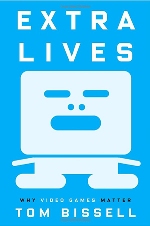
 I learned about Tom Bissell and the publication of his book Extra Lives by listening to Michael Abbott and his “Brainy Gamer” podcast. In June’s episode, Abbott spent the majority of the episode interviewing Bissell about the idea of video game criticism in general and writing the book in specific. Since reading “The Lester Bangs of Video Games” by Chuck Klosterman in Esquire in 2006, I have quietly tried to see if any authentic voice has risen to the challenge. Have we finally found a voice that specializes in explaining what playing a given game feels like? Or provides meaningful analysis of what a game mean in a context outside of the game itself?
But to continue down an overly-long prelude about the book, I feel obligated to note that I am interested in Abbott for more than just his attempt to answer Klosterman — if that was Abbott was trying to do in the first place. No, what really captured my interest in Abbottis the fact that he is a Theater professor at my alma mater, Wabash College. In the Fall of 2008, Wabash Magazine published a profile on Abbott highlighting his Brainy Gamer work and the Center for Inquiry. In August of this year, Wabash posted the profile online. I suspect this may, in part, be in reaction to the Abbott’s inclusion of Portal as a text in his freshmen seminar. The blogosphere suffered a few minutes of apoplexy in response before being distracted by Halo: Reach. (Then again, the profile could also have been posted in anticipation of a second feature in the Fall 2010 edition of Wabash Magazine. Abbott is writing this second piece to discuss his experiences with Brainy Gamer. — Nah, it was about the press.)
Okay, now that I have digressed rather far afield, let me get back to the topic at hand, namely the book Extra Lives by Tom Bissell. Well, maybe not. I mean, I’ve given you enough leads to start your own discussion about the roles of video games in education, art, literature, entertainment, business and attention deficit disorder-derived hysteria. My work here is done. Besides, I’ve got a book to read.
Oscar Villalon writes in his review for NPR:
Parts memoir, criticism and reportage, freely mixing the high with the low, Extra Lives channels the author’s intimate history with games into something richer. At its simplest, the book charmingly informs us about the massive complexity and taxing labor entailed in producing a marquee title like Gears of War or Fable II. At its finest, Bissell’s book is a thrilling attempt at providing a critical framework for understanding and judging video games. [….] Lauding the medium’s great achievements and sharing his irritation with its longstanding flaw, Bissell makes a convincing case that video games are inching toward art, if not some mind-bending realm. Extra Lives, thanks to its insight and passion, may well end up providing one great push toward that end.
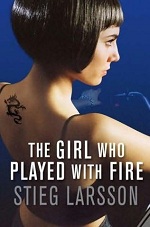 The second component of my birthday present from Mooch and Sarah was the second installment of the Millennium Trilogy by Swedish writer Stieg Larsson. The Girl Who Played with Fire picks up right where The Girl with the Dragon Tattoo left off returning to the complicated lives of Lisbeth Salander and Michael Blomkvist.
  For my birthday Mooch and Sarah gifted me with the very last copy of The Girl With the Dragon Tattoo left in Chicago. All other copies have been sold, borrowed or stolen to accompany summer vacationers, weary business travelers and college students returning for the fall semester. It seems like I must be the last man standing who has not read this book. I am exaggerating a little bit about receiving the last copy in Chicago. I am not exaggerating about the widespread interest this book has generated or how frequently I have encountered people reading it — particularly travelers. On my last trip to Los Angeles, I counted over thirty copies on board the plane. And I was flying Southwest. There are only 137 passenger seats on each of their planes. Almost one passenger in four was reading this book.
 Travel times are here again. And travel — particularly airplane travel — means reading. Call me anachronistic, out of it, behind the times: I prefer a low-tech paperback to high-tech alternatives any time I travel. Batteries expire just at the exciting part. Earphone buds and charging cables run off and elope with essential plot devices, fascinating characters and narratives. And they don’t return my calls to their cellphones. Assuming I can even get reliable service. No. Give me a book. Give me a big paperback book. I’ve yet to have a paperback crash on me even when I’ve dropped one in the ocean. The data are still recoverable. The story goes on.
  My friend and collegue Dan brought this
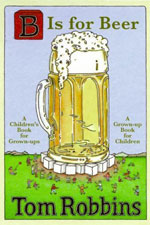 A children’s book for grown-ups, B Is for Beer is Tom Robbins’ tribute to beer. Christian Toto of the Denver Post describes it as “social satire gussied up as children’s literature.” That description immediately alarms me; I have to wonder whether Toto has read anything else by Tom Robbins. The review goes on to suggest he’s at least familiar with Tom Robbins, but I’m not sure Toto quite gets Robbins. And that is, of course, part of the brilliance of Robbins as a writer. He’s surprising and whimsical and clever and poignant. Tom Robbins is one of my favorite authors.
  I have been recommending
  No, I’m not talking about the Bruce Springsteen album — although I do have that album and have enjoyed it a great deal. The Boss doesn’t do zombies. And this is a zombie novel. Steamboat Wille lent it to me so if there is some reason I end up disliking the book, I can conveniently blame him and escape any sense of culpability. As an aside, after about fifty pages in, I am enjoying it, so I think he’s off the hook. The Rising is the first novel by Brian Keene. It won Keene a Bram Stoker Award in 2003. It’s the story of a zombie uprising, but an uprising unlike the more familiar George Romero fashion.
  I came late to reading Ian McDonald. A couple years ago I read the second of his recent popular science fiction novels, Brasyl. I skipped the book that appears to have put him on the map, River of Gods. I am trying to remember why I did that, and what occurs to me is that I couldn’t find River of Gods in the bookstore and Brasyl had just been released. So maybe I picked it up as a book of opportunity. I remember being underwhelmed by Brasyl. And while I appreciated what McDonald was trying to do, I never felt fully satisfied by the execution of it. It didn’t compel me. It didn’t pull me in to a world like I had expected it to do. At some fundamental level, it just didn’t seem to work.
 Beta|Erinyes