 My first experience with Wax Trax Records happened in the mid-80s. I happened upon the store late. The founders had moved on to Chicago to start a record label by the same name. They maintained ownership of the original store in the seedy Capital Hill area of Denver, just south of Colfax Avenue behind the state capital. The store served as a pilgrimage site for me every time I would head up to Denver for any reason. If my friends and I were headed up to see a concert, we always allowed several hours to go to Wax Trax. It was part of the ritual. Today, when I talk to my friends about record stores—bemoaning their deaths with quiet, romantic sympathy—it is often Wax Trax that I am talking about. I can recall asking the clerks about the association between the Denver store and the Chicago label on my second or third visit. By that time the focus had shifted from the Denver punk scene to Chicago industrial. The store combined elements of both major musical movements in a way unique to the entire state of Colorado.
The Wax Trax store helped introduce me to a huge number of bands I would never have discovered otherwise: Front 242, Hüsker Dü, KMFDM, New Order, Sisters of Mercy, Joy Division, My Life With the Thrill Kill Kult, Depeche Mode, Nine Inch Nails, Sinead O’Connor, Ministry, Bauhaus and the Revolting Cocks.
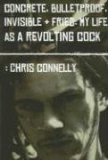
So when I began talking to my friend and co-worker, Bruce, about our various hobbies a few months back, he began describing his interest in music. I talked about my reintroduction to photography. He would show me the various specialized tubes he had purchased for his music equipment. I would talk to him about lenses and darkrooms. Bruce is a quiet, introverted, highly skilled engineer. I respect him a great deal. He has a passion for elegant technical solutions to difficult problems and the experience and track record to back up his quiet confidence. He also moonlights as a sound engineer and plays guitar in his own band. Some time ago we began exchanging books as well. I have lent him On the Road by Jack Kerouac and Rock On by Dan Kennedy. He just lent me the recently-published Chris Connelly autobiography: Concrete, Bulletproof, Invisible and Fried: My Life as a Revolting Cock. I have just started reading it.
The book promises to open up the lives of the people who were in the middle of the music scene I only orbited second-hand in Denver. The back cover reads:
Connelly’s superbly written, funny, irreverent, and sometimes downright scary memoir is one of the finest portrayals of a man trapped in the eye of a post-punk industrial storm this side of Armageddon.
In it Connelly attempts to paints a fair, but disturbing picture of a drug-addicted, out-of-control tyrant in Al Jourgensen, the founder of Ministry. He describes both the personalities and places with wit, originality and humility. The book includes a litany of hallowed Chicago nightlife institutions from the 80s and 90s: places like Smart Bar, ChicagoTrax, and Cabaret Metro. Places I missed by four or five years as I moved to Chicago too late to experience most of these at their prime. My visits to those places came after Wax Trax Records filed for bankruptcy in 1992. Seattle grunge was on the rise, not Chicago industrial.
I wonder if there is a connection there to draw upon with my relationship to my child bride. Whirl arrived in Chicago out of the grunge scene of the Pacific Northwest where I came to Chicago through this musical path. I will have to think about that as I turn the pages and get back to you.
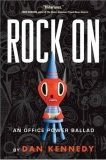 I perused a couple of the local bookstores a few days ago. I was looking for a copy of The Long Goodbye by Raymond Chandler. I found it. I bought it. I have completed reading it. At the time I was looking for it, however, I stumbled upon Rock On by Dan Kennedy. I picked it up, read the back cover and thought of my friend Smokes. Some of you may remember that Smokes was one of the champions of the
 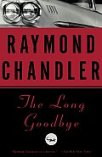 Twice a year– once in the spring and once in the fall– the Chicago Public Library selects a book for the entire city to read. This spring, “One Book, One Chicago” enters its seventh year as a program to promote reading and discussion among all city residents. The selection is the 1953 Raymond Chandler crime novel, The Long Goodbye. The choice of The Long Goodbye marks the first time that the committee has selected a mystery novel. I do not usually read mysteries or crime novels. Those tend more often to be Whirl’s preferences rather than mine. Occasionally she will recommend one for me to read, most notably novels by James Ellroy. I am also somewhat amused that the 1974 Robert Altman film adaptation by the same name arrived in the mail yesterday. I do not remember which of us added that to the movie queue, but the accidental timing was perfect. And I should probably also note that another Chandler adaptation sits on my short list of favorite films: The Big Sleep starring Humphrey Bogart. Suffice it to say I am excited to read this book.
 It is uncommon for a film to have a dramatic impact upon me. While I like film as a general rule and I enjoy discussing them with my friends and family, I generally reserve my highest praise with more than a little caution. To confess in public to a film having significant impact upon me is quite rare. In the case of a film based on a book, it is more likely for me to read the book first, and then see the film than the other way around. For whatever reason, Into the Wild happened in reverse. Of the films I have watched in the last year, Into the Wild is my favorite. Sean Penn adapted the film’s screenplay from the 1996 Jon Krakauer book of the same name.
 Three years ago, in January 2005, I suffered a serious traumatic brain injury. The injury placed me in a coma for ten days and the hospital for weeks more. The injury changed my life. Since that time I have looked for voices and means of expression of what I went through and continue to carry with me.
 I knew the Oscar-nominated film There Will Be Blood was inspired by the novel Oil!. What somehow slipped through my awareness was that Upton Sinclair was the novel’s author. This would be the same Upton Sinclair who wrote The Jungle, the seminal novel about the Chicago stockyards in the 19th Century. I ran across the recent printing of the novel browsing the bookstore last week. I picked it up.
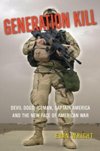 The wars in Iraq have figured as prominent cultural events in my adult life. I arrived in Berlin two weeks before the 1991 invasion and experienced firsthand the anti-American sentiment that decision fostered. When I returned to the States, I noticed how differently my experiences were from those of my friends and family. Germany’s perspective on war is different from that of many other nations, the US included. The last seven years have been characterized by various iterations of the terror war. I believe, in time, America’s involvement in Iraq will become the defining characteristic of my generation– more culturally significant than the Internet, the cellular phone, or Seattle grunge rock.
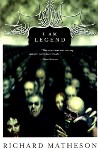 Richard Matheson wrote the apocalyptic novel, I Am Legend, in 1954. It is the story of the last man alive in a world overrun by a changed, bestial version of humanity. It is partly a vampire story. It is partly a zombie story. It is one of the definitive end of the world stories. I cannot help but hear Michael Stipe‘s rapid-fire mumble in the background as I read it. The novel has been adapted into film three times: Vincent Price starred in The Last Man on Earth in 1964. Charlton Heston starred in The Omega Man in 1971. Will Smith stars in the recently released film by the same name, I Am Legend. While I have only ever seen The Omega Man, I understand each of these film adaptations differ from the original novel in varying ways. I like a good vampire story; I like good zombie stories too. And you just can’t go wrong with positing the end of the world in gruesome ways.
 I’ve been following Barack Obama since his his 2004 Senate bid to replace the seat vacated by Republican Peter Fitzgerald. A number of people claim that his presidential campaign began with his keynote address at the 2004 Democratic National Convention. The 2004 Illinois senate run was filled with scandal and controversy on the Republican side of the ballot. In the general election, Obama received 70% of the vote to Alan Keyes‘ 27%. It was one of the largest margins of victory in Illinois history. When he officially announced his candidacy for US President in February, I was thrilled. The turnout in Iowa has further bolstered support in Illinois, and the midwest in general.
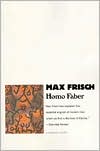 I discovered Max Frisch in the very early spring of 1991. I was living in Tübingen, Germany and picked up Homo Faber on the recommendation from a friend of mine at the university. The title is Latin for “man the maker”: a creature who controls his environment with tools. Stefan based his recommendation on my literary interests of the day and my desire to read modern literature in German. By the time I had completed the book, Max Frisch had died and Volker Schlöndorff had completed a
  Beta|Erinyes