 The short biography of Richard Bachman— written in 1984– states, “Bachman was a fairly unpleasant fellow who was born in New York and spent about ten years in the merchant marine after four years in the Coast Guard. He ultimately settled in rural central New Hampshire, where he wrote at night and tended to his medium-sized dairy farm during the day. [He and his wife, Claudia,] had one child, a boy, who died in an unfortunate accident at the age of six (he fell through a well cover and drowned). Three years ago a brain tumor was discovered near the base of Bachman’s brain; tricky surgery removed it.” Bachman died suddenly in February of 1985. He was killed by the Bangor Daily News when that paper published a story that Richard Bachman was actually Stephen King. King confirmed the story immediately.
The Bachman Books now refer to five novels written early in Stephen King’s career: Rage (1977), The Long Walk (1979), Road Work (1981), The Running Man (1982) and Thinner (1985). I read all of these but Thinner late last year. Blaze is now the sixth Richard Bachman novel in the classic sense: namely a novel originally written early in King’s career– before Carrie. The book jacket reads:
A fellow named Richard Bachman wrote Blaze in 1973 on an Olivetti typewriter then turned the machine over to Stephen King, who used it to write Carrie. Bachman died in 1985 (“cancer of the pseudonym”), but in late 2006 King found the original typescript of Blaze among his papers at the University of Maine’s Fogler Library (“How did this get here?!”), and decided that with it little revision it ought to be published.
Blaze is the story of Clayton Blaisdell, Jr.– of the crimes committed against him and the crimes he commits, including his last, the kidnapping of a baby heir worth millions. Blaze has been a slow thinker since childhood, when his father threw him down the stairs – and then threw him down again. After escaping an abusive institution for boys when he was a teenager, Blaze hooks up with George, a seasoned criminal who thinks he has all the answers. But then George is killed, and Blaze, though haunted by his partner is on his own.
With more than a nod to the John Steinbeck classic Of Mice and Men, Blaze promises to be a mix of classic storytelling by a young man who was convinced he was writing for the ages and edited by an older author who has succeeded in doing just that.
 Not ten minutes after I finished reading The Mist, Whirl pressed this collection of Stephen King stories into my hand, Everything’s Eventual. She pointed out the inclusion of at least two Dark Tower-related stories: “The Little Sisters of Eluria” and “Everything’s Eventual”. When I cracked the binding I also discovered the collection includes the story “1408”. Whirl and I watched the movie adaptation of that story just a few weeks ago.
 Stephen King published The Mist twice before: the novella is included both as part of a broader 1980 anthology of horror stories from various authors entitled Dark Forces and in a 1985 collection of entirely Stephen King stories, Skeleton Crew. In conjunction with the movie adaptation of the story, publishers have brought a new, standalone, version to market. I had to take a quick trip to St. Paul, Minnesota for work, so I dragged this along for something to read on the plane. It is interesting to me to note that my plane left the Minneapolis-St. Paul runway just as a powerful winter snowstorm descended on the region.
 A few years ago I had the opportunity to attend a reading at the Printers Row Book Fair. Neil Gaiman read from his children’s story, The Wolves in the Walls. He spoke about writing and comic books and film. He told stories about his life and his family. At the time, The Wolves in the Walls was not yet published. Dave McKean had not finished most of the artwork. After he had read the story, Gaiman took questions from the audience and signed books. I had recently finished his novel, Neverwhere, and had added him to my ever expanding list of favorite authors. I have anticipated each of his new books as they come out.
 Wild Ducks Flying Backward is Tom Robbins’ latest book. This anthology contains short stories and poems, reviews and essays written throughout Robbins’ career. Some of the material in this collection appeared previously in publications ranging from Esquire to Harper’s to Playboy to the New York Times. His introduction is a story in itself, describing the anticipation and culmination of opening your new Tom Robbins’ book for the first time. He describes the steps necessary to ensure privacy for this intimate encounter: finding the proper climate, the proper space and reminding us that “every halfway serious reader is perpetually subject to a form of coitus interruptus.” Those issues addressed, he continues to the heart of the matter:
 In 1940, Robert Heinlein wrote the story “The Roads Must Roll”. The rolling roads in the title were high-speed conveyors that connected cities. They carried people, freight and even restaurants and bars along for the ride. The express lanes of these roads had a top speed of 100 miles per hour. It is now sixty-seven years later and the best we can do to approach this idea are the moving walkways of Helmut Jahn‘s Concourse 1 out at O’Hare. That’s damned disappointing, right there. Don’t even get me started on the promises of flying cars, underwater resorts, moon colonies, and X-Ray glasses. And, hey! Where is my jetpack!?
 The Chicago Public Library picked The Crucible as the Fall 2007 selection for
  At the turn of the 20th Century, the sisters Ada and Minna Everleigh ran one of the most upscale brothels in Chicago: the Everleigh Club. The house, decorated with perfumed fountains, mirrored ceilings and a $15,000 gold-leafed piano in the Music Room, stood at 2131-2133 South Dearborn Street, not far from where Whirl and I now live. Custom House Row and the Levee District– as our neighborhoods were known at the time– were lousy with brothels and gambling halls, drifters, grifters and tramps.
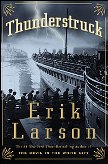 A little more than I year ago I finally read the Erik Larson blockbuster thriller, The Devil in the White City. I thoroughly enjoyed that book for a number of reasons: the book was factual, with hundreds of sources cited; it was set in nineteenth century America, a time and place with which I am repeatedly fascinated; it chronicled the 1893 Columbian Exposition that arguably brought Chicago back from the fire; and it illuminated– in great detail– the actions of one of America’s very first known serial killers.
 In 2005, TIME magazine chose On the Road by Jack Kerouac as one of the 100 best English-language novels from 1923 to then. This largely autobiographical work is based on the spontaneous road trips of Kerouac and his friends across mid-century America. Many consider this book the definitive work of the postwar Beat Generation– inspired by jazz, poetry, and drugs. I have never read it. I picked it up on my last trip to the bookstore, shortly before my trip to Pittsburgh. In college I read Blue Highways by William Least Heat-Moon while backpacking through Europe. Before that I read John Steinbeck’s Travels With Charley on a family road trip. I like to read travel journals while traveling. This time I just got distracted by something shiny– namely a certain wizard.
 Beta|Erinyes