It’s autumn, it’s Chicago and I’m looking for a new book to read. Fortunately my conscientious public library runs a nifty program twice a year to help people like me choose interesting books to read. Twice a year– once in the spring and once in the fall– the Chicago Public Library selects a book for the entire city to read. As part of One Book, One Chicago the library provides lectures, film screenings, Q&A sessions, seminars and other programs located at the various libraries throughout the city. The idea is to engage the populous in a discussion of a great book. The Fall 2008 selection is the 1979 book, The Right Stuff by Tom Wolfe. The Right Stuff tells the story of the lives of the seven astronauts chosen for Project Mercury. In the 1983 foreword to the edition I’m reading, Wolfe writes for several paragraphs about the style of military writing in the 20th century.

Immediately following the First World War a certain fashion set in among writers in Europe and soon spread to the obedient colonial counterparts in the United States. War was looked on as essentially monstrous and those who waged it– namely, military officers– were looked upon as brutes and philistines. [….] The only proper protagonist for a tale of war was an enlisted man, and he was to be presented not as a hero but as an Everyman, as much a victim of war as any civilian.

Wolfe goes on to explain that the early age of spaceflight was dominated by former military pilots. Officers. His book serves as an attempt to reconcile this era of the anti-hero with the courage and daring of not just the dangers of “test flight”, but the great unknown of spaceflight.

Chicago Public Library is presenting Tom Wolfe with the Carl Sandberg Literary Award tomorrow night at the Harold Washington Library across the street. Tickets to the dinner are going for a grand a piece. I don’t think I’ll be attending, but I am looking forward to reading this bit of New Journalism. I applaud the relevance of this book’s selection on several levels.

Mass Start 3Whirl and I got up early this morning to see the start of the Chicago Marathon. And when I say early, I mean early. The sun was not yet up when we headed up to Millennium Park. I had hoped to shoot the start of the race from the BP Bridge. I am a fan of the bridge and its architect, Frank Gehry. This morning I was not a fan of When I arrived an inconvenient sign notified me that only credentialed media photographers would be granted access. I briefly considered trying to flash my Chicago Tribune badge. While having drinks with Genaro Molina and Myung J. Chun, photographers from the Los Angeles Times, at this year’s political conventions, Genaro informed me that often the company ID badge is all the credential he has needed to gain access to shoot. So I thought about it. And then thought better of it– slinking off to shoot from the Randolph Street bridge with the rest of the great unwashed.

While waiting for the race, we caught a rare glimpse of two of the peregrine falcons Whirl monitors for the Field Museum. They were circling above us, maybe forty of fifty stories up between the Aon Tower and the Prudential Building.

As the warm morning light came over the trees, thirty-five thousand people took off in a mass for the start of this year’s marathon. I was not there to cheer on anyone in particular. No one I know personally was running this year; I just wanted to be a part of the start of it. To get a few pictures and enjoy one of the last great weekends outside before autumn turns to a cold winter.

Superheroes (and a Villain)The race route traveled through twenty-nine Chicago neighborhoods. I took a number of pictures along the start on Columbus before moving to the LaSalle Street bridge. There I took a few more pictures and asked Whirl if she wanted to hop the el down to Chinatown to catch up to the leaders. But by this point she was getting hungry so we settled for a quiet breakfast at the South Water Kitchen before making our way home.

I’m not sure I’ll ever garner enough courage to try a marathon. I am fairly certain I have the endurance for it, if I put my mind to it. I’m less confident about surviving the pounding my feet and legs would take. — And I’d need to drop the rest of this weight I’ve been steadily taking off over the past year. Nonetheless, the difference between walking twenty-six miles and running them is pretty big. Still, it was impressive to see this many people test themselves against a true test of strength and willpower. For those of you who did run: I applaud you.

Well done!

I have begun down a path to dismantle one of my most interesting labs: phaedo.erinyes.org.

Almost four years ago I put phaedo together. I designed the server to accomplish a number of different tasks. Initially I wanted a server that would function as a fileserver for our home and a mailserver for Internet email. My ISP supports customers running servers on their end of consumer-grade DSL. I used the server as an experimental platform. I worked on projects involving CMS systems, SQL server, DHCP, perl, advanced sendmail and milter configurations and a number of other scenarios over the course of its life.

So in early January 2005 I got phaedo up and running and successfully installed at home. I was proud of my accomplishments. I had set up a blog under the CMS system and was searching for topics to write about. Two weeks later I found the subject that would consume me for over a year: my brain injury. The first posts I made on the system were me chronicling my injury and subsequent recovery. What I have not talked about is the curious development that the systems I was using to publish my thoughts– blog, email, chat server– were brand new constructions. I quite literally had completed the design and installation just a week or so before I went into a ten-day coma.

So phaedo’s second laboratory function came around as part of my recovery process. I had to relearn what I had designed. I had to dismantle parts and put them back together to reteach myself critical system administration tasks. This was painful and slow and filled with anxiety and distress. I desperately wanted to succeed. And brain trauma is a very effective way to complicate those sorts of broad plans– or any plans, for that matter.

Over three years later and the same server continues to putter along reliably in our loft. I have made improvements over the years and some minor changes, but at its core it is essentially the same system as the one I started to build in the week between Christmas 2004 and New Years 2005.

Technology has advanced, my work has changed. — Part of the original design was to set up a space that could function as a testbed for systems that I was working on in the office. But more important than either of those, my life has changed. I’ve come to the conclusion that I do not want to be a full-time system administrator both at work and at home. I have other hobbies that I enjoy now. I want those hobbies to provide a relief from distress, not add to it.

All of this is my overly candid way of saying that this website will be changing. This will be the last post I make on phaedo. Stephanie and I plan to continue the weblog. Stephanie has already moved her falcon journal to its new home. I invite you, one of the countless legion of faithful readers, to our new homes:


The Erinyes Weblog
https://beta.erinyes.org/
Peregrine Falcon Journal
http://peregrines.erinyes.org/

Anthony Holden is a British journalist. He has worked on a number of biographies of the British Royal family and world-famous artists. In 1990 he decided he wanted to write a book about being a professional poker player. He did, and he did, publishing Big Deal: A Year as a Professional Poker Player in 1992. Fifteen years later, Holden returned to writing about professional poker and has recently published his follow up book: Bigger Deal: A Year Inside the Poker Boom. Holden wanted to write about the changes poker has undergone since the game has become so popular: The Chris Moneymaker Effect.

Whirl reads most of the poker books in our house. And she was the one who learned about this new book and went looking for it. She tore through it in short order and encouraged me to read it as soon as I could. From the Publishers Weekly review:

Long before poker had achieved today’s stratospheric level of popularity, British writer Holden chronicled the challenges and frustrations of a year on the professional poker circuit, in 1990’s Big Deal. In this enjoyable sequel, he revisits the poker world, playing in card rooms and tournaments in Europe and America, in home games in his native London and online during 2005 and 2006. The result is a rich account of how the game and its players have changed over the 17 years since he tried (and failed) to become a professional poker player. He profiles a range of people, from poker’s living legend Doyle Brunson to the new breed of young professionals, schooled on the Internet and ruthlessly aggressive, and explores the reasons for poker’s recent, unprecedented boom. Holden is particularly good in charting the meteoric rise of online poker (and its ambiguous legal status in the United States). He’s also adept at articulating his fascination with the game: “The thrilling sense of triumph when you sense something that turns out to be right; the disproportionate despair when you’re wrong or the poker gods are against you.”

Kevin Smith likes to talk about himself. His first movie was about himself. I could argue that every movie he has ever made has been about himself in some way. He has maintained a level of communication with his friends, family and fans throughout his career– again I might argue those three categories often blend together for Smith. He likes to talk and will use just about every medium available to him to do so. Movies, lectures, comic books, mail– and the open diary. My Boring-Ass Life: The Uncomfortably Candid Diary of Kevin Smith was born out of an attempt to answer the rather pedestrian question from a fan, “What do you do all day?”

One year and 480 pages later– roughly– and we just may have something of an answer. The book contains entries Smith has written on his blog. It details mundane, daily activities. It chronicles the making of and release of his film Clerks II. And it relates the story of his friend Jason Mewes’ heroin addiction. Candid, earnest and funny in Kevin Smith’s particular style– it is a look at a year in the life of a man I view as quintessential Generation X.

John McCain Sound Check 3Tonight is the big finale for the GOP. The events tonight surround the official nomination and acceptance of the presidential and vice presidential candidates, John McCain and Sarah Palin. It’s a packed house. I can’t help but feel tonight is somewhat anticlimactic after yesterday. The tone of this past week seems to have been set on Friday with the announcement of Sarah Palin– briefly derailed by Hurricane Gustav– and then right back onto Palin. Who is she? What’s up with her daughter? Is she going to come out swinging when she speaks?

Some of those questions were answered last night and the response around the bureau today seems to be mostly of the opinion that she did well. Our journalists put together these headline stories: Chicago Tribune, “Palin fires up faithful, comes out swinging”. Los Angeles Times, “Defiant Palin comes out swinging”.

John McCain came out onto the stage early this afternoon to go through a lighting and sound check. I got the heads up from a colleague and quickly grabbed my camera to see what kind of picture I could get– if any. As I walked into the hall, my heart sunk a little bit, looking at the sea of cameramen and photographers clustered around the new stage catwalk constructed especially for McCain’s speech tonight. So I climbed up onto the center camera platform.

Nuccio DiNuzzo 2Nuccio DiNuzzo was up there in our position working out how he was going to shoot the speech tonight. He had all of his cameras and lenses with him: three bodies and about 7 different lenses. I meandered up with my Canon 40D and 24-70mm lens. Way too short to shoot anything directly. Just wide shots of context. DiNuzzo asked if I wanted to use his 400mm. I blinked and then jumped at the chance. DiNuzzo shoots Canon gear and the lenses are interchangeable among all the bodies in the EOS line. So I pulled off my lens and snapped the body onto this huge lens. The Canon EF 400mm f/2.8L IS weighs almost twelve pounds and is monstrous. For about 10 minutes, McCain came out and took in the shape of the hall.

McCain and Lieberman 2Joe Lieberman joined him at one point and McCain took some notes from a number of handlers. I snapped away for most of it. Toward the end of the sound check, DiNuzzo asked for his lens back and I went back to my shorter portrait lens. I got a couple pictures of the photographers around the new stage and one of DiNuzzo hard at work at his craft.

I thought it was very cool to get to play with that lens. For a moment I got to be a real photojournalist. If only in my mind.

So this is it! This is the last day of the two conventions. I have one more day of work tomorrow– tear down and packing up. That should go pretty quickly and easily. It will be the last major responsibility I have for this project.

I’m looking forward to going home. It has been a long, strange, fascinating trip.

Mitt RomneyI’ve decided to call tonight On the Waterfront Night at the Republican National Convention. While Governor Palin was the highlighted speaker of the evening, the hours leading up to her address were filled with speeches from several men who had campaigned for the 2008 Republican nomination. And lost. Mitt Romney, Mike Huckabee and Rudy Giuliani all took the stage to talk about the campaign, the candidates, money, terrorism, Barack Obama, and most of all change. When I saw these three names in order on the night’s speakers’ schedule I immediately added a fourth: Marlon Brando. In my head I imagined each one of these politicians doing their version of Brando’s Academy Award-winning speech:

You don’t understand! I could have had class, I could have been a contender. I could have been somebody. Instead of a bum, which is what I am.

I snagged a credential to get me into the hall for Romney and Huckabee’s speeches. I crouched behind our journalists in the daily press writing press stands to the left of the stage and looked out over the crowd of delegates. The atmosphere inside the hall during these speeches was powerful. The speakers were playing to a partisan crowd, to be sure. And the messages sent were intentionally crafted to be incendiary– firing up the base of the political party. That I did not mind; that effect is a function of these conventions. And I did not particularly mind the difference of political opinions being expressed when compared to my own. There were two particular elements I did mind: the appeal to fear and the the broad disparity between what was said to motivate and the subsequent policies enacted once in power. Mitt Romney’s attacks on liberal government were crystalline examples of the latter. Rudy Guiliani’s incessant waving of the bloody shirt the epitome of the former.

Read the rest of this entry »

Nuccio DiNuzzoSo for the first time I get to really watch the process of a full day of news production in the bureau. By the time the second day of the DNC came around and I was comfortable with the setup enough to play ‘fly on the wall’ I had to hop on an airplane and come to St. Paul. Yesterday was a highly abbreviated session due to Hurricane Gustav. So today was the first real day. It was interesting to watch, to just be a part of and absorb as it happened around me.

But I want to back up and talk a little bit about last night. I spent most of yesterday evening with two of the photographers from the Los Angeles Times. I met up with Genaro Molina and Myung J. Chun back at the hotel. I’ve been talking to them off and on over the course of the last few days, mostly legitimate work-related topics dealing with the setup and logistics of shooting the convention. What services are available where? Where can I get credentials? What’s the best way for me to upload these pictures quickly? Last night I sat down and talked with them both in some depth about their careers in photojournalism. What they like about it, what they could leave be. Challenges with competing with the wire services, particularly for Internet content. We talked about the conversion from film to digital in late 1999. The place for still photography in journalism. Chun had a number of interesting thoughts on that topic as he moved from still photography to video about six years ago.

The whole evening was entertaining and enlightening. They were both very forthcoming and engaging. I really enjoyed the opportunity to talk shop with them. And then to get to follow up that conversation with observing them work– the selection of shots, the submission, and the anxious wait to see what, if anything, had been selected. This is another of the sort of immediate, visceral experience I was hoping to have. It was good.

As for news stories of the day, they were primarily follow-up to the stories from yesterday: the aftermath of Gustav, the imminent threat of three more named storms in the Atlantic, further fallout and discussion of Bristol and Sarah Palin. Some of our journalists are still working that story. Rumor is that Levi Johnston, Bristol’s boyfriend, will be in attendance at the convention tomorrow night when Sarah Palin is scheduled to speak. A number of other journalists have moved beyond this story and on to investigate Sarah Palin’s executive work. They are taking a hard look at her apparent change in position on the Bridge to Nowhere in Alaska. Tom Kole, Broadcasting Manager of the Washington DC bureau, commented to me first thing in the morning as I arrived about Sarah Palin’s apparent change in position regarding the Federal funding about the bridge. Look for more of these sorts of stories as the news media scours her Alaskan political career.

With Gustav dissipating and the New Orleans levees still intact, hurricane hunters looked further east in the Atlantic and reported three tropical storms now with names: Hanna, Ike and Josephine. Some or all of these storms may develop into hurricanes and head toward the United States. None of them will make landfall in the US before the close of the Republican convention, however, so it looks to be a return to more normal activities here in the hall.

Jon VoightTwo other small items. First, while poking around the hall this morning before the session opened, I ran across Jon Voight on Radio Row. Radio Row is the name for a section of the conference center set aside specifically for the use of talk radio. Their setups are not particularly fancy: usually a table, three or four microphones, some audio equipment, a phone or two, maybe a television or a laptop. But there are dozens of these setups, one right next to the other running the length of the hallway. Radio Row is actually four rows set up like this in parallel. Voight had been cornered by a mob of print, radio, and television journalists when I happened across him. At the time he was answering questions about Bristol and Sarah Palin. Bristol’s pregnancy continued to be the big news story throughout the morning. Jon Voight has been vocal about his political opinions this election cycle. Last week he published an opinion piece critical of Barack Obama in the Washington Times. I suspect that publication has something to do with his appearance at the convention.

Second, Ron Paul hosted a sell-out crowd in Minneapolis today for his “Rally for the Republic”. I believe Ron Paul’s Libertarian-leaning, conservative politics pose an intriguing dynamic for the Republican party and I leave you tonight with a brief glimpse into the rally as presented by Myung J. Chun.

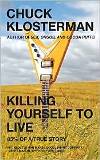
Killing Yourself to Live: 85% of a True Story is the third book by Chuck Klosterman. This non-fiction piece was first conceived as a magazine feature about death: death involving rock stars. To this end, Klosterman embarks on “epic” road trip. He wants to visit the death sites of rock stars. Klosterman rents a Ford Taurus– make that a “Ford Tauntaun” and tours the country to stand where 119 rock stars have fallen. Almost all of them unwillingly. If you are familiar with Klosterman’s work, you know that nothing he does is ever simple. Things happen to Chuck Klosterman. Sometimes banal, sometimes bizarre, often neurotic and most of the time quite entertaining.

Another through-line to the book is Klosterman’s attempt to reconcile people, places, things and ideas that he loves with, well, women. Oh, and of course the recreational drug use. Sex, drugs and rock n’ roll. Or cocoapuffs. Take your pick.

I’ve enjoyed a couple of Klosterman’s other books and when selecting something to bring with me while I did networking support for coverage of the two political conventions I picked this one up. I don’t think I’ll be disappointed. Just listen to the back cover:

For 6557 miles, Chuck Klosterman thought about dying. He drove a rental car from new York to Rhode Island to Georgia to Mississippi to Iowa to Minneapolis to Fargo to Seattle, and he chased death and rock ‘n’ roll all the way. Over the span of twenty-one days, Chuck had three relationships end– one by choice, one by chance, and one by exhaustion. He snorted cocaine in a graveyard. he walked a half-mile through a bean field. A man in Dickinson, North Dakota explained to him why we have fewer windmills than we used to. Chuck listened to the KISS solo albums and the Rod Stewart box set. At one point, poisonous snakes became involved. The road is hard. From the Chelsea Hotel to the swampland where Lynyrd Skynyrd’s plane went down to the site where Kurt Cobain blew his head off, Chuck explored every brand of rock-star demise. He wanted to know why the greatest career move any musician can make is to stop breathing … and what that means for the rest of us.

React QuotesHurricane Gustav made landfall south and west of New Orleans today as a Category 2 storm. This was down from the Category 3 classification last night. Many meteorologists expected Gustav to grow in strength to Category 4 rather than lessen. So the hurricane made landfall with strong winds, rain, tornadoes and storm surge of 6-8 feet. We’ll see what sort of long-term impact the storm has for Louisiana and Texas over the next several days, but initial reports seem to indicate that this hurricane has not had the dramatic effect that Katrina and Rita did three years ago. I may be premature, but I suspect that its impact on the Republican National Convention in St. Paul will be minimal and shortly the convention will return to its more typical course of events.

Rather than Gustav, the big story of the morning at “The X” is Bristol Palin. Bristol is the 17 year-old daughter of Republican vice presidential candidate, Sarah Palin. Bristol is five-months pregnant. Apparently this story came to light today in an attempt by the McCain campaign to rebut the rumors that Palin’s youngest child was actually her daughter’s. Steve Schmidt, McCain’s senior campaign strategist, was outside our workspace talking about the news. What began as a small group of 3 quickly grew into 20 or more. To the point where the crash of journalists and photographers threatened to knock down our temporary walls. Inevitably the media tried to get a reaction quote from Barack Obama. Obama responded in a way that reminded me of Bill Clinton, “I have said it before and I will repeat it again: people’s families are off limits. People’s children are especially off limits. This shouldn’t be part of politics.” He refused to say anything about Bristol Palin. Meanwhile, I overheard Aaron Zitner, an editor for the Los Angeles Times, say regarding the timing of the story, “Just when I wake up and say no one should be working on deadline today. We’ve been working all these days straight. The campaign serves up something just so incredible.”

So, go out there and read the papers, find out all the rest of the scandal. These people are working hard to bring it to you.

Read the rest of this entry »