 Three years ago, in January 2005, I suffered a serious traumatic brain injury. The injury placed me in a coma for ten days and the hospital for weeks more. The injury changed my life. Since that time I have looked for voices and means of expression of what I went through and continue to carry with me.
The Diving Bell and the Butterfly is the English translation of the French memoir Le scaphandre et le papillon written by journalist Jean-Dominique Bauby. Bauby served as editor-in-chief of the French fashion magazine ELLE. In December 1995 at the age of 43 his life changed. He suffered a massive stroke. The results of the stroke included complete and permanent paralysis of almost all his voluntary muscles while retaining nearly full awareness of his senses. Vision, hearing, tactile sensation remained absent any ability to act upon the information those senses provided. This rare condition is known as “locked-in syndrome”. For Bauby, his sole means of communication to the outside world was the ability to blink his left eye.
Using that one remaining ability, Bauby wrote and edited this book– painstakingly, tediously, letter-by-letter, two minutes per word, he wrote the book over the course of a year. The book gives voice to his thoughts and feelings about his life and the situation in which he found himself. The title serves as a clear description: the diving bell refers to the empty shell he considered his body, the butterfly refers to his spirit. The book was published in 1997. Two days after publication, Bauby suffered a heart attack and died. His astonishing book continues to give cheer to those who face life’s ultimately impossible odds and the confrontation of the sudden, merciless, fickle nature of life. The book serves as an inspirational reminder of mortality: the plain fact that swift and sudden changes can sweep away anything we might have taken for granted.
From the book’s back cover:
In a voice that is by turns wistful and mischievous, angry and sardonic, Bauby gives us a celebration of the liberating power of consciousness: what it is like to spend a day with his children, to imagine lying in bed beside his wife, to conjure up the flavor of delectable meals even as he is fed through a tube. Most of all, this triumphant book lets us witness an indomitable spirit and share in the pure joy of its own survival.
 I knew the Oscar-nominated film There Will Be Blood was inspired by the novel Oil!. What somehow slipped through my awareness was that Upton Sinclair was the novel’s author. This would be the same Upton Sinclair who wrote The Jungle, the seminal novel about the Chicago stockyards in the 19th Century. I ran across the recent printing of the novel browsing the bookstore last week. I picked it up.
 The wars in Iraq have figured as prominent cultural events in my adult life. I arrived in Berlin two weeks before the 1991 invasion and experienced firsthand the anti-American sentiment that decision fostered. When I returned to the States, I noticed how differently my experiences were from those of my friends and family. Germany’s perspective on war is different from that of many other nations, the US included. The last seven years have been characterized by various iterations of the terror war. I believe, in time, America’s involvement in Iraq will become the defining characteristic of my generation– more culturally significant than the Internet, the cellular phone, or Seattle grunge rock.


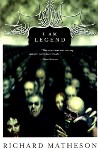 Richard Matheson wrote the apocalyptic novel, I Am Legend, in 1954. It is the story of the last man alive in a world overrun by a changed, bestial version of humanity. It is partly a vampire story. It is partly a zombie story. It is one of the definitive end of the world stories. I cannot help but hear Michael Stipe‘s rapid-fire mumble in the background as I read it. The novel has been adapted into film three times: Vincent Price starred in The Last Man on Earth in 1964. Charlton Heston starred in The Omega Man in 1971. Will Smith stars in the recently released film by the same name, I Am Legend. While I have only ever seen The Omega Man, I understand each of these film adaptations differ from the original novel in varying ways. I like a good vampire story; I like good zombie stories too. And you just can’t go wrong with positing the end of the world in gruesome ways.
 I’ve been following Barack Obama since his his 2004 Senate bid to replace the seat vacated by Republican Peter Fitzgerald. A number of people claim that his presidential campaign began with his keynote address at the 2004 Democratic National Convention. The 2004 Illinois senate run was filled with scandal and controversy on the Republican side of the ballot. In the general election, Obama received 70% of the vote to Alan Keyes‘ 27%. It was one of the largest margins of victory in Illinois history. When he officially announced his candidacy for US President in February, I was thrilled. The turnout in Iowa has further bolstered support in Illinois, and the midwest in general.
 I discovered Max Frisch in the very early spring of 1991. I was living in Tübingen, Germany and picked up Homo Faber on the recommendation from a friend of mine at the university. The title is Latin for “man the maker”: a creature who controls his environment with tools. Stefan based his recommendation on my literary interests of the day and my desire to read modern literature in German. By the time I had completed the book, Max Frisch had died and Volker Schlöndorff had completed a
 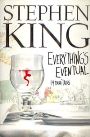 Not ten minutes after I finished reading The Mist, Whirl pressed this collection of Stephen King stories into my hand, Everything’s Eventual. She pointed out the inclusion of at least two Dark Tower-related stories: “The Little Sisters of Eluria” and “Everything’s Eventual”. When I cracked the binding I also discovered the collection includes the story “1408”. Whirl and I watched the movie adaptation of that story just a few weeks ago.
 Stephen King published The Mist twice before: the novella is included both as part of a broader 1980 anthology of horror stories from various authors entitled Dark Forces and in a 1985 collection of entirely Stephen King stories, Skeleton Crew. In conjunction with the movie adaptation of the story, publishers have brought a new, standalone, version to market. I had to take a quick trip to St. Paul, Minnesota for work, so I dragged this along for something to read on the plane. It is interesting to me to note that my plane left the Minneapolis-St. Paul runway just as a powerful winter snowstorm descended on the region.
 Beta|Erinyes