Haymarket Affair Reenactment 13
Today is May Day. In many countries, May Day is celebrated as International Workers’ Day, or Labor Day. It is a day of political demonstrations and celebrations organised to commemorate the fight for the eight-hour workday. May First was selected to commemorate the people involved in the 1886 Haymarket affair right here in Chicago. And while America celebrates a Labor Day of its own — established as a federal holiday in 1894 under President Grover Cleveland — the date of May First was intentionally avoided. Instead Cleveland selected the first Monday of September. As such, Labor Day’s American celebrations are more low-key than the May First celebrations elsewhere around the world. I remember Labor Day as the end of summer — picnics, barbeques and the weekend the swimming pools closed.

I’m not going to even pretend to provide a summary of all of the social, political, and economic elements at play surrounding May Day other than to highlight that May Day has become an international celebration of the social and economic achievements of the labor movement and the date is inextricably linked to local, deadly actions taken in Chicago 125 years ago. I encourage anyone interested in learning about the history of socialism, capitalism, anarchism, and organized labor to read about the 1886 Haymarket affair.

To honor the 125th anniversary, a full-scale reenactment was staged on the original site — a site less than a mile and a half from my home. Groups from all across the city came together to remind people of past labor struggles here in Chicago, and the need to work together in the present. The contemporary battles over collective bargaining in Madison, Wisconsin, Toronto and Iran cast long shadows over yesterday’s reenactment of the deadly Chicago events. Whirl and I attended the reenactment. I took photographs. We listened to the various speeches and toured the site. It was a powerful reminder to me about the awesome position of privilege currently held by contemporary American society and the heavy prices paid by those who came before us, that we might enjoy them. And while I disagreed with some of the more scathing polemic deployed by and against the labor movement, I know that the lessons are there to be learned and not ignored.

I do not think in the course of human events 125 years is a particularly long time. Yet the changes seen in the day-to-day lives of people as a result of these sorts of actions are widespread, powerful and oftentimes silently assumed. We would be wiser were we to remember that.

The Chicago Public Library has spearheaded the “One Book, One Chicago” program for ten years this year. Twice a year in the spring and the fall, the library selects a book for the entire city to read and then sponsors a wide array of events associated with the book. Discussion groups, guest lectures, theatrical productions. I’ve participated in the program at least once every year, and read books I would not have chosen otherwise.

The House on Mango Street, The Long Goodbye, Go Tell It On The Mountain, and One Day in the Life of Ivan Denisovich are four such unfamiliar books.

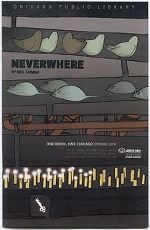
The Spring 2011 selection is quite familiar to me: Neverwhere, by Neil Gaiman. I first read Neverwhere in the Fall of 2002. It was my introduction to the author. Since then he has become one of my favorites. Gaiman originally conceived Neverwhere as a television series, and later completed a novelization of the story that avoided the more unfortunate business of writing for television.

I describe Neverwhere as a modern-day fairy tale. I’ve heard it categorized as fantasy, “a postmodernist punk Faerie Queene,” urban fantasy, and “Narnia on the Northern Line”. Most of the action is set in the magical realm of “London Below,” a parallel environment alongside the more mundane — some might say real world, normal London we’re familiar with — “London Above”. Characters include knights, noblemen, rat-worshipers and an angel. I’m loathe to title him a hero so I’ll settle for describing Richard Mayhew as simply the protagonist. Richard quickly learns that no good deed goes unpunished and finds himself propelled alongside a wonderfully imaginative allegory for a more modern age.

Besides re-reading the novel, I participated in two associated events as part of the “One Book, One Chicago” program. Friday night, Whirl, T and I went on a Neverwhere-themed tour of “Chicago Below” exploring the Chicago pedway. Last night, Steamboat and Hurricane joined Whirl, T and me to attend the conversation on imagination and creative with Gaiman and Audry Niffenegger at Harold Washington Library.

At the top of the agenda was establishing a connection between the book’s origins and Chicago. Gaiman summarized what he’d written earlier in a letter:

It was a quarter of a century ago, about 1986. I had recently read a book set in Chicago called Free, Live Free by Gene Wolfe (he’s local to you; the Washington Post has said Gene Wolfe may be the best living writer America has) and I had started thinking too much about cities.

What I had started to think about was that some cities were also characters. Chicago was, in Free, Live Free. It was drawn in such a way that it had become almost magical, and was as much of a character in the book as any of the more human people who walked around in it.

The two authors exchanged anecdotes before taking questions from the over-capacity audience. The estimated attendance was announced north of 700 people. The auditorium only seats 385. It was crowded. I took that as a good sign. Gaiman told a hilarious story about the creation of Coraline, including a reference to some advice from Larry Niven to “treasure your typos.” I found the insight he presented about his fascination with the House on the Rock refreshing. Gaiman featured the House prominently in my favorite of his novels, American Gods.

Neverwhere made me a fan of Gaiman’s work. Having the opportunity to see him speak was delightful. It’s exciting for me to see the book featured so prominently by the library — for so many people to be exposed to an incredible, wickedly creative author.

Na'vi

Yesterday Whirl and I attended C2E2, the Chicago Comic and Entertainment Expo. We met up with our friends Farmboy and Princess. The three-day convention covers comic books, movies, television, toys, anime and video games. The show floor plays hosts to hundreds of exhibitors if you’re looking to score some interesting loot. There are panel discussions and autograph sessions that allow fans access to artists, actors and writers. And the ever-popular sneak-peek film and television show screenings. This was the second year for C2E2. Last year was fairly lightly attended, but well-received.

I wasn’t particularly interested in spending three days at the convention, but I thought it would be a nice way to spend a Saturday afternoon. And besides, I’ve always wanted to pull out the camera and see what kinds of cosplay portraits I could make.

We attended two panel discussions. The first was “The Walking Dead Q&A” with Jon Bernthal (“Shane”) and Laurie Holden (“Andrea”). This was very funny, with Bernthal running away with the conversation on more than one occasion. Farmboy remarked a couple of times about Bernthal’s apparent southern California origins. While I have no idea whether that’s true or not, I can attest to the fact that his choices of slang and colloquial idioms stagnated somewhere around 1989. Everything was “rad” and he was “totally digging” working with Frank Darabont. The highlight of the panel came about two minutes after all the press photographers filed out and Bernthal found himself trapped in a nearly three-minute long string of unintentional double-entendres. Each more embarrassing than the last.

The second panel was the “True Blood Q&A” with Brit Morgan (“Debbie Pelt”), Kristin Bauer (“Pam”), and Sam Trammell (“Sam Merlotte”). While not quite as entertaining as the Walking Dead panel a few hours earlier, it did provide some moments of levity and one crucial insight into acting from Morgan. While answering a question about contending with the various supernatural stressors placed upon the characters they portrayed, Morgan talked about becoming a sort of legal advocate on the set, with their character as their client and the director as the judge. The two women also agreed that Alexander Skarsgård is even more beautiful in person than he is on-screen. Trammell was conspicuously — and humorously — mute with his opinion on that question.

We walked the floor between the panels and took in the environment. There was a lot to see and photography was not only permitted, but actively encouraged. Aside from the challenges of making a frame with a halfway acceptable background, it was an exceedingly target-rich environment. The skill and creativity that went into a number of the costumes impressed the hell out of me more than once. I’ve published the full set of photos, but a few of my favorites include:

Muppets 1

The Chiditarod Urban Iditarod, a shopping cart race and mobile food drive, is an idea stolen from some folks in New York (who in turn stole it from some people in San Francisco).

Inspired in part by the Alaskan Iditarod dog sled race, an urban iditarod replaces dogs and sleds with shopping carts and costumed heroes.

Tobias Fünke 12011 was the sixth annual running of the race in Chicago and this year the start of the race coincided with the start of the Alaskan Iditarod race. The weather in the morning was cool with some light snow flurries and continued to deteriorate over the next several hours. Winds kicked up. Snow turned heavier and icy. Whirl and I dressed for the weather, packed up the cameras and spent the afternoon running alongside the racers on the streets of East Village, Wicker Park and Ukranian Village shooting the race. Whirl reprised her standout role as photo shoot producer, providing operational support and keen insight into composition and dramatic moments worth capturing.

She also was our navigator, which was no easy task. There were a total of twelve checkpoints. Each team had to complete a circuit of five of these checkpoints. So two given teams would not necessarily follow the same route, in fact no specific route is prescribed. Teams must appear the the assigned checkpoints in the appropriate order. That made it somewhat challenging to capture the entire scope of the race with a single camera. We tried!

The race did not disappoint. There were over 170 teams and the mass start was truly something to behold as racers streamed down the street and out into the surrounding neighborhoods to their respective checkpoints. We ran into one of Whirl’s classmates who had worked on one of the most incredible entries of the race, the immense ten-man Titanic entry. Their entry actually comprised two teams of five racers each. One team was the bow of the doomed oceanliner, one team was the stern. Of course the ship was appropriatedly broken across the beam.

Titanic 3We saw two teams of Muppets, three teams of Black Swans, Angry Birds, Gnomes, an Oregon Trail team — complete with a boombox broadcasting the appropriate 8-bit MIDI soundtrack.

The Chiditarod is not just fun and games however. It is a food drive that collects thousands of pounds of food for the Chicago Anti-Hunger Federation every year. Additionally, checkpoint hosts donate signification portions of their proceeds from the day’s events to charity. All of the teams, carts, costumes and creativity are donated — put together out of spare time, ingenuity and willingness to do something good for other people.

Devo 1 Derailers 1 Don't Tread On Me 1 Samurai 1 Finish Strong

Like me, many of my friends also work in technology. From time to time, we succumb and wage the various holy wars about particular bits of tech with one another. One such protracted battle — a battle I am steadily losing by attrition — is the holy war over the “one true editor.” Vi vs. emacs. Recently Princess and Farmboy fired a salvo across the bow of my ship-of-the-line: emacs.

And while another approach might have been to yell, “Avast, ye scurvy dogs!” and open fire on these ninjas, instead I responded in song.

“Like a EMACS”
Music by: Far East Movement
Lyrics by: DJ Bingo

Poppin tildes on the files, like a blizzard
When we code, we do it right gettin LISPer
Slippin regexp in my style, like three splats
Now I’m feelin so fly like a EMACS
Like a EMACS, Like a EMACS
Now I’m feelin so fly like a EMACS

Gimme that Per-Per-Perl
Gimme that Py-Python
Ladies love my style, in my syntax gettin on
Get them tildes poppin, we get that push and that pop
Now give me two more buffers cuz you know it don’t stop

Hell Yeaah!
Code it up, code-code it up,
When source compile around me, they be actin like they run
They be actin like they run, actin-actin like they run
When source compile around me, they be actin like they run

Poppin tildes on the files, like a blizzard
When we code, we do it right gettin LISPer
Slippin regexp in my style, like three splats
Now I’m feelin so fly like a EMACS
Like a EMACS, Like a EMACS
Now I’m feelin so fly like a EMACS

Sippin on, sippin on init, Ima ma-make it diff
Girl I keep it gangsta, poppin buffers at the fringe
This is how we live, every single night
Take that buffer to the head, and let me see you fly

Hell Yeaah!
Code it up, code-code it up,
When source compile around me, they be actin like they run
They be actin like they run, actin-actin like they run
When source compile around me, they be actin like they run

Poppin tildes on the files, like a blizzard
When we code, we do it right gettin LISPer
Slippin regexp in my style, like three splats
Now I’m feelin so fly like a EMACS
Like a EMACS, Like a EMACS
Now I’m feelin so fly like a EMACS

Chandelier at CosmopolitanNow that Whirl and I are snowbound at home under the blanket of the 2011 Groundhog Day blizzard, I’ll see if I can’t piece together the threads, fragments, snippets and fabrications into some sort of interesting narrative about our sixth annual trip to Las Vegas. In case you’re curious, we already have have 9 inches of snow, 40-50 mph winds, whiteout conditions, 15-25 foot waves on Lake Michigan, lightning and thunder. Thunder. In a snowstorm. I saw the lightning with my own eyes. The thunder was eerily muffled by the snow. Predictions are for 3″ to 4″ per hour from now until 5 AM Wednesday morning. So, let it snow. I can’t stop it, I might as well appreciate it.

As we have for the past two years, we stayed at the Flamingo in the middle of the Las Vegas strip. This year I started collecting bits of observation about our stay there. We’ve noticed there is something a little peculiar about the music that constantly plays throughout the casinos. A particular songs will repeat with uncanny frequency. The song is often older — 15 or 20 years past its prime — once popular, but not one I would consider a particularly impressive classic. This ad-hoc themesong is recognizably dated. The first song to strike us in this way several years ago was Tom Cochrane‘s “Life Is a Highway“. This year we set about actively looking for the themesong. We came up with three candidate songs:

I was partial to naming the Roxette song as our themesong. The other two had strong arguments supporting them. All three meet the requirements and I personally heard all three of these mostly forgettable melodies at least three times in three different places around the Strip.

The other element I began tracking began with less preparation. I was inspired by a spontaneous conversation that erupted in front of Steamboat and me as we made our way across the casino floor. We were following a group of four girls who were walking in two groups of two. Each of the four women was dressed in the requisite Las Vegas nightclub uniform: the little black dress or its variation the little black miniskirt paired with a shiny silk blouse. Requisite too-high heels and a tiny clutch finish the ensemble. The forward pair were making a path through the mingling crowd, and it was the latter two that we unintentionally overheard. I should correct that statement. One of the two was rather despondant. Her head was down. She did not make eye contact. Her companion, walking beside her and perhaps a halfstep behind, was ostensibly comforting the other woman. The speaking voice was cool, uninflected — almost mechanical — as it chanted.

You’re sexy. You’re beautiful. You’re totally rockin’ that outfit.

It struck me as the sort of ironic environmental commentary one might hear while running around Las Venturas while playing Grand Theft Auto. I bust out laughing. I couldn’t help it. The unsympathetic, detached tone contrasting so vibrantly with the constructed projection of a particular look and persona.

I began to collect a few more snippets of overheard conversation from around the Flamingo. Here they are, ripped of any context and stripped of intentional irony:

  • “Dude, are those Flamingos?”
  • “Rawhide cleavage.”
  • “Well, I guess I can’t see your cleft lip from behind.”

Other random encounters included a long conversation at the craps table about the probabilties and strategies of betting against the shooter, witnessing someone win a $9000 jackpot on a slot machine, and discussing the probable meaning of a typo-laden text message on a woman’s phone. (I agreed, it did seem like her boyfriend was asking her if she wanted a burger and fries even if the text itself looked closer to “gurger nad frips.”)

Besides the typical gambling on poker, pai gow and craps, we took in a few new things this time around that we haven’t enjoyed on previous trips. Bitsy and I designed a team jersey for all of us. The jersey included a logo, nicknames and numbers. We all wore them boarding the plane, and from time to time throughout the weekend while in Las Vegas. It was goofy and frivolous, but fun. It also made it very simple to find each other on the casino floor. Hurricane‘s mother, Sibyl, celebrated her birthday with us on Friday. We combined that event with an idea AK and I had had after his trip to Dallas late last year. We went to Tom Colicchio‘s restaurant, craftsteak. Bitsy and I had agreed to try one of the tasting menus. And after a bit of discussion we recruited T. to our plan. With that phalanx in place, we quickly set about convincing the rest of our table to try the same. And as a result we had one of the best meals I have ever had. We enjoyed five different cuts of wagyu beef, delicious appetizers, sides and more than a dozen different deserts. The entire experience lasted almost four hours: from the scotch before dinner to the final cup of coffee at the end. It was an incredible way to spend an evening. Bitsy and I agreed that it would be a fine thing to incorporate into future Las Vegas trips.

niqui, Whirl and I enjoyed fantastic sushi one night. I went to have delicious Thai and Vietnamese food with Bitsy, T., AK and niqui. And I could not pass up the opportunity to return to Hash House A Go Go for breakfast. I failed to finish the crispy hand hammered pork tenderloin benedict even after our waiter challenged me to do so. He’d only served one person that day who had successfully joined the clean plate club with that dish. If I had succeeded, he would have bought my breakfast, and a t-shirt. I didn’t make it.

Las Vegas Gun Range 9

The Flamingo added a brewery to the property since last year: Sin City Brewing Company. Saturday night I proposed to Steamboat that we grab some of their fresh-brewed beer and enjoy them outside for a couple hours. That turned into a makeshift gathering around a firepit and extended far beyond what I had originally intended. Plastic cups, beer from kegs, a fire, outside. It reminded me of a party from twenty years ago. Except with much better beer. And I’m not twenty.

Earlier Saturday I joined Steamboat, AK and T. on their second trip to the Las Vegas Gun Range and Firearm Center. I haven’t been to a range in many years — perhaps I should consider this a special time machine side trip. We fired a number of weapons including a M-16, a Desert Eagle .50ae, a HK MP5, a HK USP Tactical .45 suppressed, a Carl Gustav M/45 SMG, and a 12 gauge semiautomatic tactical shotgun. I was the only one of my friends who had done any shooting of any real significance. They were very excited about the experience and I had as much fun firing rounds as I did shooting photographs of them.

John on Fremont Street Zipline 1Our last night in town we headed down to Fremont street. AK and niqui had never been there, so we showed them around the older casinos, gambled a bit. I hadn’t been downtown for a couple years. Some things had changed — most notably the addition of a zipline running the length of Fremont Street above the pedway. Smokes took the plunge and rode the line before we departed to pack up and come home the next morning.

But on our last night, after encountering more than my fair share, I got to thinking about a potential collective noun for a group of douchebags. Suggestions included: affliction, clot, flush, hemorrhage, purge and smear. We reached agreement on the term: hemorrhage. So there you have it: a hemorrhage of douchebags. Coming to a casino near you.

Preposterous.

Thanks to my degenerate friends, I came into a little bit of cash at our poker game last week. Friday I spent my poker winnings on a pair of hockey skates and then proceeded to immediately head over to Millennium Park and try them out on the outdoor rink. Returning to the ice is (as I’m sure you have surmised) phase three of my time machine project.

I skated regularly as a kid. My hometown has a nice, full-sized ice rink. As an added bonus, the rink was only lightly used. Everyone else wanted to play baseball, I think. The rink had a lot of good things going for it. It was close to my dad’s office. It was open year-round — which made it particularly appealing on those scorching days of summer in the desert. And it was across the street from the best comic book shop in town.

I skated there a lot growing up. I desperately wanted to play hockey there but lost on appeal in the court of parental oversight. We had a number of popular roller-rinks in town as well, but I always preferred the ice rink. It was great.

So here I am, twenty years older and not a day wiser, strapping on some new skates and heading out onto the ice once more. Of course I invited my friends to join me. Many were convinced this had to be one of the worst ideas I have ever come up with. Tempting horrible physical and psychological trauma this close to the anniversary of that Brain Mishap. That’s saying something, because I’ve had some really bad ideas over the years. T. was more supportive:

You win the prize for picking the cutest group activity chosen by a grown ass man.

At least I think she meant that supportively. You don’t think she was being cynical, do you?

So anyway, some scheduling complications meant that we scheduled two trips to the ice rink this past weekend. The brief one Friday night at Millennium Park. T., Hurricane, and niqui joined Whirl on the sidelines while Hurricane and I skated for a while. We did a longer skate Saturday afternoon. Whirl has never ice skated.

So Saturday when we regrouped. Farmboy, Princess, niqui, Whirl and I met over at the smaller outdoor rink at Daley Bicentennial Plaza on the north side of Grant Park and skated for a couple hours. Whirl and Princess both skated for the first time ever. Nobody got hurt. Both newcomers did really well and said they had a lot of fun and would like to do it again. It was a great time outside on the ice.

Farmboy put on a strong pitch to get my skills up and consider joining him in a pick-up amateur hockey league and I have to say the proposal has a lot of appeal.

All time travel stories have to contend with the issue of paradox. Farmboy’s proposal and its implementation inside my time machine raises that issue in a very personal way: What would happen if I were to travel back and time and defy the ruling of the court of parental oversight?

Tomorrow I fire up the second phase of my time machine project. Tomorrow I’m attending my first class at the Goethe Institut. I signed up for an eleven-week course in intermediate German after completing the Einstufungstest. This is something I’ve wanted to do for years as I slowly stood by and allowed my language skills atrophy with lack of use. This January marks the twentieth anniversary of the beginning of my year abroad in Germany. Personally, socially, academically — that year was one of the most enriching times in my life I have ever experienced. And now looking back on it I feel that I have squandered some of what I worked so hard to develop while there. I’m setting out to recapture it before it is gone entirely.

So with that mindset firmly fixed in place I stepped into the offices of the school — just a few blocks from where I live — and turned in the written portion of my exam. I underwent the subsequent oral examination. The speaking component was much less formal, much more conversational than the written. Despite that informality I felt self-conscious, almost embarrassed for myself. I knew that I knew how to do this, and yet I didn’t. I floundered. I stammered. I reached for words that at one time I knew were ready at hand only to have them slip traitorously from my grasp.

I’ll get them back.

They might have escaped me this once, but I will get them back. I’m determined. I’m excited. Walking home from the institute down Randolph and Wabash I felt a version of the same rush I remember when walking across the Kurfürstendamm in Berlin to get back to the small apartment I shared with my fellow students from Geneva. I’ve taken to thinking this is a sign that my time machine is working.

When I got home I collected my trusty Duden, and my Langenscheidts Kurzgrammatik. The next day I headed over to Beck’s Book Store to pick up my textbooks for the course. It’s been fifteen years since I’ve done anything like this.

Tomorrow: jetzt geht’s los!

I’m building a time machine. It’s not an actual machine. It’s not some device that will bend space and time or carry me to another period in history. No the machine I’m building is mostly in my mind. And when I come right out and think about it, it’s not a machine at all. It’s a mission — an assignment I’ve given myself to re-energize interests and activities from earlier in my life. I got to thinking about all the things that my friends were doing for themselves in the spirit of a principle AK first mentioned to me a couple years ago when we were working together: “personal enrichment”. He told me about how he liked to take on particular projects for himself not to necessarily do something for any particular overt benefit. He took up craft brewing. He learned how to ride a motorcycle. No fame, no fortune, no name in lights. Nothing like that. But just to do something that would expand his life. Give him a new skill, a new experience. Personal enrichment.

I thought it was a great principle. I like the sense of initiative. I like how it serves to break routines and avoid getting stuck in ruts — bad habits.

And more recently I’ve noticed a number of things that my friends have been doing that I might also categorize as “personal enrichment”. They’re hobbies, really, but they’re hobbies followed up with passion and importance that provide a sense of well-being. T. told me this week that she is setting a goal for herself to read every Hugo Award winning novel. Hurricane, Steamboat, niqui, Farmboy and Princess are all going (or going back) to school to pursue a college degree. Bitsy is starting to aggressively train for RAGBRAI this summer. niqui is training for a triathlon this spring. Princess wants to learn how to knit.

So I decided to pursue my own little “personal enrichment” activities. And what I’ve chosen to do is to return to activities I used to enjoy twenty years ago or so. In the interim, for one reason or another I had abandoned them. My return to photography was the first of these activities. It’s a sentimental return to a version of myself from twenty years ago, but seen through the eyes of someone twice that age. Time travel in my head.

In November, 2007 I started working out regularly and dropped a significant amount of weight. Last month I returned to the swimming pool for regular exercise. I added swimming as part of my “eat less, move more” diet plan. I like this plan for its simplicity. I eat what I want; I just eat less. And I make sure and move a little bit each day. I walk to and from work. I was going to the gym three times a week– now five. Today marks six weeks of adding swimming to the mix of workouts. Swimming again feels very good but I have to say this was way easier when I was 18. Last week I hit the one mile milestone I’d been working towards. I’m feeling comfortable in the water again. Now I’m trying to see what I can do to start building up a bit of speed. I was surprised how quickly it came back to me. I’m not looking to be competitive. I’m not doing this to be part of a race. I’m just doing it to feel better about myself, to provide a bit of relaxation and tranquility. I mentioned to Whirl that I was particularly appreciating the sense of isolation that the pool provided. Since returning to the gym I’ve been doing most of my workouts during my lunch. It provides a good break from sitting at my desk, gets me out of the office and reinvigorates me for the afternoons. I use the time to listen to music or podcasts and just take myself out of whatever stressors are surrounding me in the workplace.

Swimming removes even those potential distractions. It’s just me and the water. I think about breathing. I count laps. The rest is empty.

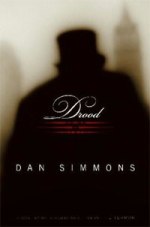
Dan Simmons likes to write about writing. But he does it in a way that I can’t call academic — even though I know there is a considerable amount of academic legwork that goes into each of his novels. Simmons is a storyteller; he’s a storyteller that likes to tell fictions that are “mostly true”. Which is say, not true at all. But it resembles the truth. Or casts a shadow of truth behind it somewhere. Simmons writes about what he knows and Simmons knows authors. Earnest Hemingway, John Keats, Mark Twain— they’ve all made appearances in Simmons novels. Drood features Charles Dickens described with an unsteady hand by Dickens’ unreliable contemporary and friend, Wilkie Collins.

The setup from the back cover reads:

On June 9, 1865, while traveling by train to London with his secret mistress, fifty-three-year-old Charles Dickens — at the height of his powers and popularity, the most famous and successful author in the world — hurtled into a disaster that changed his life forever.

Simmons has talked about writing this novel for almost a decade. He originally considered the title, The Great Oven. In the intervening years the structure has changed and the plot focused upon the last five years of Dickens’ life and Dickens’ own uncompleted work, The Mystery of Edwin Drood. Those last five years shroud a sharp shift in behavior from the world’s most popular author. It makes a fantastic setting for a mystery. Dickens, Collins, Simmons investigate the worst slums of London. The Whitechapel of Oliver and Jack.

And a ghoulish figure named Drood.