 Four years have passed since the events that catalyzed my resolve to keep this blog. Not that I have been particularly prolific or profound with what I write here, but the simple task of writing down anything that comes to mind has been a useful project to me. I’ve employed this blog for a few notable projects: to chronicle my recovery from the brain injury, to catalog what I’m reading, and most recently to remark on the work and experiences involved with the 2008 political conventions. Sometimes I talk about travels and entertainment. I fear that mostly I just stumble from thought to thought to shiny thing before asking myself: isn’t that what life often is? So here is my post about Pink Las Vegas. Last week Whirl and I traveled to Las Vegas with several friends to mark the anniversary of my brain injury. The annual Las Vegas trip has transformed into a ritual for us. A woman Whirl and I met described the annual celebration as “a second birthday” after we explained why we were in town. In a lot of ways that is exactly right. It marks a second chance at life — my life’s mulligan.
 I have been disappointed in the Sookie Stackhouse novels. I attribute the Golden Globe award more to the cleverness of Alan Ball than the skill of Charlaine Harris or Anna Paquin. On the other hand, I have heard good things about this debut novel by the Swedish writer John Ajvide Lindqvist. So I have picked up Let the Right One In (the original Swedish title is Låt den rätte komma in). Like many horror novels, this book focuses on the darker side of humanity. Let The Right One In uses the genre to contend with drugs, theft, pedophilia and prostitution. With the exception of the Harris novels, I haven’t read much contemporary horror in a while. I’m hopeful that this novel will be more satisfying.
Booklist provides this short summary:
Swedish TV and stage writer Lindqvist’s first novel is set in a commonplace suburb of Stockholm, where 12-year-old Oskar lives with his mother, is bullied at school, shoplifts, and keeps a scrapbook of notes and clippings about gruesome murders. Eli, apparently about his age, moves in next door but doesn’t go to school, leaving the flat only at night. Shortly after, the killings start. At first more fascinated than sorry, since one victim had bullied him, Oskar eventually discovers that Eli is a vampire, stuck permanently in childhood. What should Oskar do, especially when Eli is his friend as much as anyone is? Lindqvist develops the plot in rich detail. The characters, adult and child, are quite convincingly the sort that one would probably cross the street to avoid in any city. Lindqvist also realistically depicts the aftermath of brutal homicide on the nearby: shock and horror, some sleepless nights and bad dreams, despite which you must go to work and get the groceries.
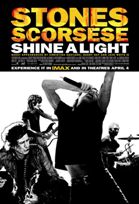 You’re the Rolling Stones. You want to film one of your concerts. Who do you ask to do that? Martin Scorsese! Just let that image percolate in your mind for a minute. A Rolling Stones concert shot as a Scorsese film. Don’t worry. The concert doesn’t end with a pile of dead bodies across the front of the stage. Jagger, Richards, Watts and Wood are very much alive. And they rock! The result is Shine a Light.
Scorsese intercuts the concert footage with behind the scenes looks at the pre-production concerns. Jagger’s fixation on the danger of the big boom cameras. Scorsese’s neurotic obsession about the absence of a fixed playlist. Historical news clips and archival interviews with band members round out the rest of the film and provide a more three-dimensional look at where the Stones fit into the history of rock and roll. Add Jack White, Buddy Guy, Christina Aguilera and Bill Clinton to the lineup and you have a fantastic, star-studded evening in a beautiful venue: the historic Beacon Theater in New York City.
Scorsese has often used Stones music in his films. In an interview about the documentary Jagger joked that Shine a Light may be the only Scorsese film that does not include “Gimme Shelter”. Brilliant entertainment.
 Spencer and Templar gave me The Moment It Clicks as a Christmas present. Joe McNally has been a professional photographer for decades. This book is part coffee-table book and part text book. He deconstructs various photographs into lessons learned, technical explanations and human anecdotes. This thoughtful gift is as beautiful as it is insightful. The vast majority of McNally’s thoughts and examples are about light — finding it, seeing it, wrangling it to submission that you can use it to complete your particular vision. Each of these lessons are marked with a simple declarative sentence and then explored in detail.
Some of the concepts McNally distills to one succinct sentence:
- Pay attention to the small pictures
- Don’t pack up until you leave
- Get your hands on your subjects
- Don’t light all of it
- Make light available
- Think like a comic book
- Stand in front of more interesting stuff
- Always something to bounce light off of
- It’s gotta speak for itself
McNally reminded me that the word photography comes from the combination of the Greek words φώς (phos) and γραφίς (graphis). He transliterates this to mean: writing with light. I love that idea.
 John Gordon writes that Marley & Me is a story about his life and love with the world’s worst dog. I disagree. My family had dogs as pets all the time I was growing up. We had good dogs and bad dogs. Smart dogs and dumb dogs. My parents still have dogs. I sometimes tease my mother that when I went away to college she replaced me with a dog. I’ve grown up with pets as part of the family. When I moved to Chicago most of the places were I rented apartments had fairly draconian rules against dogs. That suited me fairly well, as I believe that having a yard is a prerequisite to having a dog. No yard, no dog. I know people without yards make it work with dogs. There’s a woman with a loft in Printer’s Row who has two Great Danes. I often see her walking them around the neighborhood. Anyway, my pets in Chicago have been cats. Quirky, wonderful, sneaky, loving cats. I don’t mean this as a slight on dogs or people who like dogs. I like dogs, too. A lot. This is all rambling pretext of no particular relationship to this book– other than to add that Mom read this book a while back and suggested it to me with the warning that she cried through the last several hours of it. Because really, I don’t think this is a story about a misbehaved dog so much as it is a story about the value of animals in our lives. And that transcends any species or breed.
 Nothing says zombies quite like Christmas. You think I’m kidding, don’t you. You think that zombies should be relegated to Halloween. Well, it’s true. Zombies are an excellent metaphor for the conspicuous consumption of Christmas. This is not an original claim on my part. George Romero pointed it out in 1978 when he set Dawn of the Dead inside a shopping mall. Where did the zombies congregate? The shopping mall. Powerful stuff.
Zombies have returned to the cultural forefront in a big way in the last several years. A number of excellent zombie movies have been produced, including a remake of Dawn of the Dead, 28 Days Later, Land of the Dead and the spoof, Shaun of the Dead. Max Brooks published a fantastic zombie novel, World War Z. Stephen King recently did a take on the zombie legend with Cell. A number of really good video games have focused on zombies, recently, as well: Stubbs the Zombie, Dead Rising, Left 4 Dead, Dead Space. Zombies are hip and cool. And terrifying.
So when the Chicago Zombie organized a skating event at one of the most touristed locations in Chicago in the middle of December, I grabbed my camera and ran to get some pictures. Zombie hordes shuffling into Millennium Park and out onto the ice begs to be photographed.
What do you want for Christmas? Braaaaaains!
 Today I learned Bill Placher has died. Bill Placher was one of the most influential men in my life. I am overcome with grief. I met Bill my freshman year at Wabash College. I took courses with him in Ethics, ancient Greek philosophy, Dante‘s Divine Comedy, Enlightenment philosophy, Augustine and Thomas Aquinas. He became my college advisor. He guided me through my major. He encouraged me to study abroad and advocated the unconventional approach of my direct enrollment at Universität Tübingen in Germany.
My sophomore year Bill thrust the novel, Hyperion, into my hand and challenged me to interview his classmate, Dan Simmons.
Fall of my junior year, Placher taught a seminar on Dante’s Divine Comedy. The seminar met once a week, on Friday afternoon. There were 27 students in the class. This was twice the usual size of a Wabash seminar. The first week I remember Bill commenting on the class size, “Who could have anticipated there would be this many of you wanting to talk about Hell late on Friday afternoons.” It was a testament to Placher’s influence.
When I returned to Wabash after my year abroad I would often spend evenings with him at his home. We would talk about our respective experiences — he had studied abroad in Aberdeen, Scotland when he was a Wabash student. A byproduct of those evening meetings was my education into the wonders of scotch whisky. The distinct smoke-filled flavor of Islay’s Laphroiag was Placher’s favorite malt.
We reprised this tradition of evening conversation whenever I would return to Crawfordsville. I had the opportunity to return the favor when he took a sabbatical at the University of Chicago in 2000-2001.
I still organize my academic library by the principle Bill first showed me. I recall walking into his office one afternoon to discuss a paper I was writing and looking for some secondary literature to help me make my point. I had a couple of particular books in mind. Placher was on the phone when I entered but encouraged me to browse his bookshelves. I began looking and it occurred to me that these books were shelved in an entirely unfamiliar way. He had hundreds of books on his shelves. Philosophy, theology, religion, literature. At first impression the collection seemed entirely haphazard, random. And I was put off by that conclusion. It did not make sense given what I knew about him otherwise. Something structured his library — I just hadn’t struck upon the organizing principle. Eventually I arrived at what seemed a likely conclusion and set about finding the texts I had originally sought. When Bill finished his phone call I tested my hypothesis. “Are your books ordered historically?” I asked. He revealed his own quiet grin and admitted as much. We talked at length about how that came about and I still lean heavily on the lesson I learned from the experience: that history and knowledge is a conversation. To set these books in a historical order is a way to physically place these texts in conversation to one another.
In some cases, the interlocutors are close: Kant‘s awakening from his dogmatic slumbers in response to reading David Hume. In others the interval between episodes in the conversation take place across generations. Aquinas responding to the Church with references to his friend, Aristotle. This quirky principle struck me as clever, subtle and sound. We do not live or write or think in a vacuum. To organize the greatest symbols of that task in such a way that celebrates the continuous conversation of thought underlines Bill Placher’s sublime brilliance. — This was a recurring theme in his life and his teaching: to encourage conversation. I doubt there was something he loved more than intelligent conversation.
I am using these encouragements, challenges and academic anecdotes to illustrate how Bill Placher embodied the spirit of the liberal arts: to think critically, act responsibly, lead effectively, and live humanely. These are not easy tasks, and often we hamper our own ability to accomplish them.
Bill wrote to this point in his 2007 text, A Triune God:
We human persons are always failing to be fully personal. As persons, we are shaped by our relations with other persons. Yet we always deliberately raise barriers or cannot figure out how to overcome the barriers we confront. When those we most love come to die, or in the dementia of old age are no longer able understand what we may most want to say to them, we realize how much there was in our hearts that we never shared with them. When we best articulate our ideas, we cannot escape the feeling that there was something there we never quite captured. When we most rejoice in sharing with someone different from ourselves, difference nevertheless scares us. The doctrine of the Trinity, however, proclaims that true personhood, however impossible its character may be for us to imagine, involves acknowledging real difference in a way that causes not fear but joy.
Relationships built upon honest interaction, typified by sincere conversation, celebratory of differences, relishing the new, the other and confronting these truths of life without retreating into the dark caves of fear– these are lessons I hope never to forget. Ideals by which I strive to live my life. I draw these principles in part from my time with Bill Placher. And I am left with exactly that realization he wrote of: there is so much in my heart that I never shared with him.
I will leave it to others to catalog Bill Placher’s accomplishments. They are not insignificant, but his influence upon me was not defined by what he wrote or where he studied or what awards he won. His influence and inspiration are defined by who he was, how he lived– how he spoke. And so I redouble my efforts to live in a way guided by his quiet, clever teachings and wit.
 One of our traditions is to build gingerbread houses with Spencer and Templar sometime between Thanksgiving and Christmas. We started doing this probably ten or eleven years ago, while Spencer and Templar were attending graduate school and before Hill or Danaan were born.
The first year we each built our own construction. I constructed the John Hancock Building. Whirl built a jail scene from rural Louisiana. Spencer succeeded at a traditional gingerbread house, and Templar added a giant “atomic duck” to Spence’s backyard. The next year we decided on a combined project: a big gingerbread castle. Spencer was in charge of all the Disneyesque fantasy themes while Whirl, Templar and I subverted it with candy-on-candy warfare. We deployed a gummi bear army to defend Gingerbread Castle and rallied a huge band of marauding barbarian marshmallow men to assault it. The castle grounds were covered in candy-gore. We cut gummi bears in half and dripped red food coloring over the icing for blood. We constructed small siege engines and then smashed them. It was deliciously gorey. This set the tone for the project from then on. A somewhat coordinated effort using the combined creativity of the group, limited by the construction properties of gingerbread and the availability of particular cookie cutters.
The third year we built a zoo — but not your ordinary zoo this one came complete with a Jurassic Park-styled velociraptor pen. Of course in our version of the zoo the velociraptors escaped and began eating the hapless gummi bear zookeepers. We had giant gummi worms, and gnostic bears worshiping a mysterious coyote-god. In 1999, we included our friends Viv and Rio in on the fun and built a Star Wars: Phantom Menace inspired gingerbread pod race. (Templar built a Sarlacc Pit to go with it.)
For several years the gingerbread tradition languished when Spencer, Templar and Hill moved to Philadelphia. We got together for Thanksgiving in 2004 in Philadelphia and reprized the tradition in an abbreviated form, building a Gingerbread Race Track for Hill and his Hot Wheels.
 This year we got back into the full swing of things and built the Gingerbread Field Museum. While we considered adding some horrorshow elements to the construction, we generally kept things on an even keel, and did our best to try and represent the museum in gingerbread. We included elements of well-known exhibits like Sue, the lions of Tsavo, the hall of gems and Bushman the Gorilla. Whirl meticulously fashioned a pair of peregrine falcons out of jelly beans and installed them on frieze above the south entrance.
We are not particularly reverent with our portrayals. Spencer has pictures from several of the years projects, but most of them were shot on film. We talked about scanning them in sometime and including them online. If she can find them.
This year’s was big. It took the six of us — four adults and two children — about six hours to complete. It measures a little more than three feet wide by two feet deep by about a foot high. Both Spencer and I took pictures before, during and after the construction.
It will remain at the Perry’s house and serve as decoration, snack and dessert for the next couple weeks. The candy usually goes first, and then the gingerbread. Sacrifices to the spirit of Christmas sugar.
 The HBO series “True Blood” concluded its first season a couple weeks ago. The television storylines followed most of the first book, Dead Until Dark, fairly closely. But with about four episodes left in the season the television series veered off into territories not covered by the first volume of the book series. Now that Season One of “True Blood” is concluded, I’m interested to see where Alan Ball drew his inspiration. Living Dead in Dallas is the second novel in the Sookie Stackhouse vampire mystery series by Charlaine Harris. In this novel we return to Bon Temps and the now somewhat familiar supernatural world of telepaths, vampires and various other things that go bump in the night before heading off to Texas for further nocturnal adventures. These are quick, easy reads of not terribly weighty substance. I enjoyed Harris’ first book and Ball’s first season. So I’m coming back for more.
I’m amused more than anything. I also agree with Ross Wolinsky that there are at least 8 Things Modern Vampires Could Learn From The Lost Boys. I’m just sayin’.
 Impulse buys at the bookstore can be dangerous. I went into the bookstore yesterday without a particular idea of what I was looking for. I enjoy browsing bookstores for this very reason. Despite attempts to try and replicate the experience online with recommendations, reviews and customer profiling I cannot get over the idea that it just is not the same as moving from shelf to shelf through a well-stocked bookstore. So that’s what I do when I’m looking for something to read and don’t have a clear idea of what is is I’m looking to read. Yesterday I found Gods Behaving Badly, the first book by London anthropologist and BBC researcher Marie Phillips.
The novel’s structure is straightforward in this postmodern era. Take some bit of classical culture — in this case twelve Olympian Gods — and place them somewhere disconnected from their expected environment. Let’s say a flat in 21st Century London.
The twelve Greek gods of Olympus are alive and well in the twenty-first century, but they are crammed together in a London town house — and none too happy about it. For Artemis (goddess of hunting, professional dog walker), Aphrodite (goddess of beauty, telephone sex operator), and Apollo (god of the sun, TV psychic), there’s no way out — until a meek housecleaner, Alice, and her would-be boyfriend, Neil, turn their world upside down.
When what begins as a minor squabble between Aphrodite and Apollo escalates into an epic battle of wills, Alice and Neil must fear not only for their own lives but for the survival of humankind. Nothing less than a true act of heroism is needed — but can these two ordinary people replicate the feats of the mythical heroes and save the world?
Well, it sounded like a great premise to me.
 Beta|Erinyes