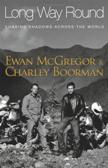
 It’s spring of 2004. Ewan McGregor and Charley Boorman are trying to decide what to do with their summer. They come up with an incredible plan. Both are motorcycle enthusiasts and they want to do something unique. They decide to take the summer off and ride motorcycles around the world. They plan to start in London and end in New York City. And since they are planning something so singular, they decide to film it. Then they decide it would be better if someone filmed it for them. I imagine the initial conversation going something like this:
Charley, what do you want to do this summer?
Let’s ride our motorbikes around the world!
Brilliant!
Yes. Let’s ride through Ukraine, Kazakhstan, and Mongolia.
I’ve always wanted to see Mongolia!
And there’s this road here, look at the map. We can ride that.
The Road of Bones. Sounds bloody fantastic, it does!
One problem.
What’s that?
We haven’t got any motorbikes.
Right.
So McGregor and Boorman put together a crew, hire a Swiss cameraman, and get to work finding sponsors. What results is this incredible television documentary about their 115 day trip, Long Way Round. McGregor and Boorman use the journey as a vehicle to bring attention to UNICEF’s humanitarian work in Ukraine, Kazakhstan and Mongolia– including a powerful stop in an orphanage housing children affected by the Chernobyl disaster.
I am enjoying this series on a number of levels. It is a travel piece about a part of the world I know very little about. It shows a more unscripted side of celebrities. It underlines the distinction between tourism as a commercial enterprise and traveling as a journey. And McGregor and Boorman are witty and shrewd, authentic and charming.
I was pleased to learn that on 12. May, 2007 this crew began a second trip of a lifetime. They are traveling from from John o’ Groats at the northernmost tip of Scotland to Cape Town at the southernmost tip of Africa. They will ride through Central Europe and Eastern Africa. Again the pair are riding with a film crew and in support of UNICEF. This second trip of a lifetime is called Long Way Down. I invite to follow along through the BBC website associated with this trek.
 In March of 1996, Outside magazine sent Jon Krakauer on an expedition to climb Mount Everest. Krakauer’s editors wanted him to write about the increasing commercialism of the summit. Krakauer stated he had given up mountain climbing long ago. He agreed to the climb for purely professional reasons. He later revised this statement, confessing a reawakened desire to climb mountains– like the heroes of his childhood once had done.
 I will never understand the rivalry that exists between the fans of Chicago’s two baseball teams. I think it is something that develops at birth. I was not born here. I did not grow up here. I missed out. I came to Chicago as an adult. Granted, a tabula rasa when it came to professional baseball– but I still missed out. I think it is too late for me.
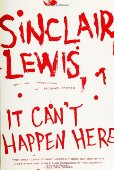 Sinclair Lewis was an American novelist and playwright. His novel, Main Street, was to be awarded the Pulitzer Prize in 1921. The Columbia University Board of Trustees overturned the jury’s decision. Five years later, Lewis again was awarded with the Pulitzer, this time for his novel Arrowsmith. Lewis refused. In 1930, Lewis became the first American author to win the Nobel Prize in Literature. Insightful and critical, satirical, and sympathetic– It Can’t Happen Here is Lewis’ last great work. This speculative novel warns that political movements akin to fascism can come to power in countries such as the United States when people blindly support their leaders.
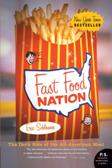 Eric Schlosser levels the following charges: fast food has hastened the malling of our landscape, widened the chasm between rich and poor, fueled an epidemic of obesity, and propelled American cultural imperialism abroad. That’s a bold statement. Schlosser first wrote about the unsanitary and discriminatory practices of the fast food industry in a two-part series for Rolling Stone magazine in 1999. He expanded that treatment into this almost 300 page book and published it in 2001.
 Sherman Alexie wrote The Lone Ranger and Tonto Fistfight in Heaven and The Toughest Indian in the World. He adapted parts of the first book into the screenplay for the 1998 feature film Smoke Signals. Flight is Alexie’s first novel in a decade. Using wit and eulogy, satire and sentimentality Alexie tells the story of an orphaned Indian boy who travels back and forth through time searching for his true identity. The book’s jacket states:
 Mike Royko wrote a newspaper column in Chicago for thirty-four years. He started at the Daily News, then moved to the Sun-Times when the Daily News shut its doors. In 1984 he left the Sun-Times for the rival Chicago Tribune when the Sun-Times sold to Rupert Murdoch, claiming, “No self-respecting fish would be wrapped in a Murdoch paper.” His column was syndicated to some 600 papers around the country. He won fans, antagonists and awards– including the Pulitzer– for his work.
 Rick Kogan works as the host of WGN radio’s “Sunday Papers with Rick Kogan” and a senior writer and “Sidewalks” columnist at the Chicago Tribune. Years ago I counted myself a regular at the Billy Goat tavern on Washington– not the original, but filled with some shared history. But I know only the myths and misconceptions. In the acknowledgements of this book about Chicago’s Billy Goat Tavern Kogan writes:
 Last night’s game between the Chicago White Sox and the Texas Rangers was a treat. It showed teamwork. It showed skill. It showed drive and determination. It was a joy to watch. Last night’s game was also the first game in major league history to feature all of the following events. Each of these is something special in its own right, but to have all three happen in one game for the same team. Incredible:
 Beta|Erinyes