 In late June, I made the decision to compete in the Big Shoulders 5K open water race. The race wasn’t until the end of summer, and since summer had only just begun, the end of it was a long time to go. Far too long to get worked up about. We’re talking June, and the race wasn’t until the second weekend in September. I mean, when I was a kid one summer was the equivalent of seven years! Maybe even more. One summer was a lifetime.
Well, June became July. July became the trip to Lake Tahoe, and before I knew it I was two weeks out from the race and asking my lane mates, Stephanie and Bernice, if they might be interested in skipping the usual open water practice and swim a test run from Ohio Street Beach to Ladder 1 and back. I figured that would be a fair approximation the Big Shoulders 5K distance. So we did. And I finished it. And I didn’t drown. (Whirl was happy for that.) I swam my regular practices in the pool, finished the last couple open water swims of the year and kept a watchful eye on the weather.
I put together this map of several of the Ohio Street Beach swim courses.
- 1 mile course from the beach to Oak Street and back (blue)
- 50 m sprints between the half-mile mark and the first ladder (red)
- 2.6 mile loop from the beach to Ladder 1 (blue)
- 2.5 km loop course for Big Shoulders (green)
Since March, the weather has been unseasonably warm. That’s kept the lake at very comfortable temperatures: ranging between 74 and 83F. I quickly learned that at those temperatures no wetsuit is required. That’s a good thing, because despite my child bride’s generous birthday gift of a new suit, I find swimming in a wetsuit an unnatural experience. I also learned that it doesn’t take much to radically change the water temperature. A good storm can churn things up so that the temperature drops 10 degrees or more in a day. I’m comfortable at 74F. 64F, not so much.
So for the ten days leading up to the race, I kept checking the weather. Day after day, everyone was reporting the same thing. Tom Skilling gleefully described a lengthy series of pleasant, sunny 85-degree days. Right up until Saturday. Race day. Skilling predicted a dramatic cold front would sweep in the night before the race that would drop the air temperature almost thirty degrees, bring rain and a strong, cold wind out of the north. You know, ideal conditions for swimming in a Great Lake. “Oh well,” I said to myself. “Can’t do much to change the weather. Not much use in worrying about it.”

Saturday morning came and part of the weather prediction was true. The air temperature had dropped dramatically, but the clouds failed to materialize. And while mom, Whirl and I rode the bus to the beach, I allowed the optimistic thought that maybe the wind wouldn’t appear either. When we got to the beach, I saw my mistake. The wind — now blowing about 10-15 mph out of the northwest — was bringing in 1-2 foot rollers right down the lakeshore along the last leg of the course. So, if nothing else, we had that going for us: we would be able to bodysurf our way into the finish. And the water was not as rough as I had swam in over the summer. Hell, it was significantly worse when we did the run to Ladder 1 two weeks earlier.
But the sun was out. The Ohio Street Bouy was reporting water temperature at 75F.
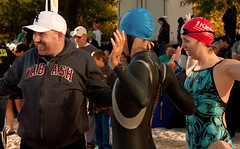 I met up with my teammates from Chicago Blue Dolphins. We worked our way through registration, picked up our goodie bags, got marked up with our numbers, attached timing chips to our ankles and waited impatiently for the course talk. At some point we started stretching with Bernice’s “I Y W t” routine and Whirl was there with the camera to capture us in the act. Stretch your arms up straight like you’re forming the letter “I”. Then “Y”. Then “W” then finally a lower-case “t”. Accompanying the stretch with a silly grin is strongly encouraged.
Before long the lifeguards took to their rowboats and took positions around the course. The elite first wave took to the water for the start. I should note here that this year’s qualifying time for that first wave was 1:08:00. Nearly three miles-per-hour.
And just a few minutes later I made my way into the water out to the start. With a rather subdued electronic beep, we were off. And the first major difference between a pool start and an open water start became intimately familiar. Pool starts, each swimmer has their own lane. There’s no contention for water or air. No one kicks you in the face or the chest. You don’t smack anyone else across the skull and you reach forward. It’s very controlled and civilized. An open water mass start isn’t. It’s a blinding churn of arms and legs and murky water. And I just hoped that I would travel along with most everyone else in the general direction of that first marker without losing my goggles.

By the time I rounded that first marker, my wave had stretched out and I was cruising along without difficulty other than the second major difference between open water swimming and pool swimming. In the lake there are no lane lines to either side, no painted lines on the bottom. Nothing. Now I’d practiced this arcane art of “sighting” all summer in our open water practices but somewhere in the excitement of the moment, I seemed to have forgotten most of what I’d learned. I swam pretty wide on several of the legs. That’s one of the areas I can definitely improve upon for next time.
After the start, the remainder of the swim fell into a comfortable rhythm. I was passed by a few swimmers from the waves behind me, and I passed a few people in the waves ahead of me. My goal was to finish the race in 1:45:00, with a stretch goal of finishing in 1:30:00. Official results were posted online in the afternoon:
 Not Ryan Lochte calibre, but I am extremely pleased. A couple points of comparision: Adam Dawkins (0:59:25) was the overall winner, Barbara Richter (1:01:51) was top finisher for the women and second only behind Dawkins. Daniel Hamzik, 69, (1:25:24) was the oldest swimmer in the race to post a finishing time in the 5K, beating my time by eight minutes. John Le Bourgeois, 74, posted a 0:53:09 in the 2.5K race. Three 60-year old women finished the 5K, Laurie Tanimura (1:34:55) was the fastest in that division. In my division, Men 40-44, there were eight of us between 1:30 and 1:34. And across all divisions there were 55 swimmers in that time range. Which tells me while I’m not the fastest by a longshot, I’m right there in the middle of things. And that gives me a great boost of confidence and inspiration to try it again next year. It really was a blast.
I’d like to thank Whirl and my mom for coming out early in the morning to cheer me on and all my friends and family who gave their support over the summer. It was exciting challenge and I am really happy to have done it.
Thank you!

 As always there are elements of gallows humor in this year’s exhibit. Several of the gummi Imagineers have caught fire on the firework floats within the lagoon– and somehow a great white shark is swimming freely after hapless prey floundering near the promenade.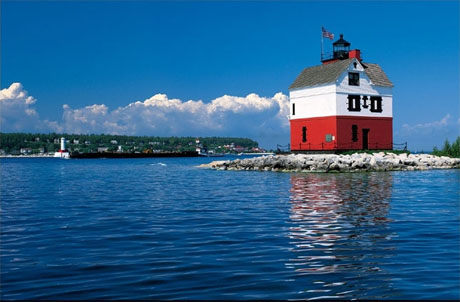
 The Book Thief by Markus Zusak is the
  Two months after I stopped working for Tribune Company, David Carr published his takedown in the New York Times,
  For many of us that grew up in the 80s, the video game arcade holds a special allure. The one I haunted at our local mall was appropriately named “The Goldmine”. I spent hours in there playing all kinds of games. And then came home to spend even more time playing on the Atari 2600. Games have always fascinated me: video games, board games, role-playing game, card games. All kinds of games, but especially the sorts of games that were published during my youth in the 80s. So when Smokes recommended that I read this book based on the premise that a quirky billionaire has created a contest based on the details and the spirit of those games, I was intrigued. Ready Player One is the first novel by Ernest Cline. I’ve read a number of various descriptions of the book: quest novel, love story, nostalgia, dystopia, “Willy Wonka meets The Matrix“, and virtual space opera are just a few. Set in a universe where spell-slinging mages battle giant Japanese robots, Ready Player One is a critical mass of 80s pop-culture. The geekier the better.
 If you’ve been reading this blog for a while now, you may have heard this story before. Here’s the short summary. Man is out and about doing something totally mundane– walking home from a friend’s house or ferrying garbage and laundry across a lake in a small boat at the end of a summer vacation– when he suddenly and violently strikes his head. He is rushed to the hospital and falls into a coma. Meanwhile, the wife, not present at the scene, rushes to her husband, and waits. Because that’s what you do when someone you love is in a coma. You wait. The patient either comes out of it or doesn’t. In our story, the man does eventually awaken from the coma. Although it’s straining credulity a little bit to say he is the same person as he was before.
 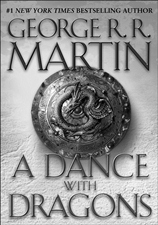 When I told Mick that I was reading the fifth book in the Song of Ice and Fire series by George R.R. Martin he offered to save me the trouble of wading through the 1000 pages to find out what happens, “everybody dies.” Mick is like a number of people I’ve met who started reading these books early. Years ago. They are interested in the series, and invested in the story. You have to be invested after 5000 pages of text about a very rich and interesting world and set of characters.
  Alright, so that went fast. It took me just two short days to finish Catching Fire, and now I’m already deeply into the third and final volume of the Hunger Games series by Suzanne Collins, Mockingjay.
 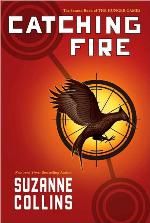 I’ve been patiently waiting for someone to publish the second and third volumes of the Suzanne Collins‘ Hunger Games series in paperback. I read the
  Beta|Erinyes