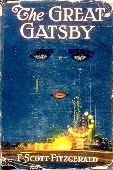
 It is not normal for me to reread a book. I read a book, I savor it as I do so. I pick the next book from my stack. A claim that Benjamin Franklin would read a linear foot of books a week inspires me. I have no idea whether that claim is true or not– a quick bit of research found nothing to corroborate it. But that is not the point. The point, as I see it, states that there are so many books worth reading that rereading one might just be a waste of time. So, as a general rule, I don’t do it. I don’t reread books.
And like most self-made rules, I’ve broken this one on a number of occasions. My latest reading selection, The Great Gatsby by F. Scott Fitzgerald, stands as my most recent transgression. I remember reading this book in seventh grade– twenty-five years ago. I remember the parties. I remember the suicide. I remember the classroom discussion about the elements that appeared to be autobiographical. Several years later I remember attending the one-woman play, Zelda, by William Luce.
In the summer of 1930, F. Scott’s wife and archetypical flapper, Zelda Fitzgerald, suffered a mental breakdown, was diagnosed with schizophrenia and was committed to a sanitarium. Luce’s play is set in a psychiatrist’s office in that sanitarium the night before Zelda died in a fire. She spent the last seventeen years of her life in that hospital. In Luce’s play, Zelda claims Scott placed her there not because she was crazy, but rather so that he could carry on his selfish, indulgent lifestyle without her interference. Zelda recalls how F. Scott Fitzgerald used their lives together as source material for his novels. She charges he stole her diaries: he included her private confessions in his own books. And she rejoins that her own novel, Save Me the Waltz, tells her side of their story– and displays her own talent.
Inspired by these works of art and psychology, I have, on occasion, introduced Whirl as my Zelda Fitzgerald. Given the treatment Zelda suffered, and the depiction in Luce’s play, my moniker may not seem particularly affectionate. I don’t mean it that way. I can be a melancholy boy. The conflict– even torment– of life and art fascinates me. Zelda Fitzgerald fascinates me in that I view her as personification of that conflict.
So twenty-five years later, I am returning to what is arguably the supreme achievement of F. Scott Fitzgerald’s career. To a time and place when the New York Times noted, “gin was the national drink and sex the national obsession.”
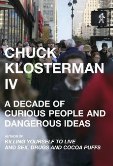 Chuck Klosterman has created a collection of previously published essays as Chuck Klosterman IV: A Decade of Curious People and Dangerous Ideas. The title is a tribute to Led Zeppelin’s untitled fourth album– commonly known as Led Zeppelin IV. He breaks the volume up into three sections: Things That Are True, Things That Might Be True, and Something That Isn’t True. Publishers Weekly describes his work, “Whether investigating Latino fans of British pop icon Morrissey, interviewing female tribute bands like Lez Zeppelin and AC/DShe or eating nothing but Chicken McNuggets for a week, Klosterman is always entertaining and often insightful.” My friend Smokes turned me on to Klosterman with Sex, Drugs and Cocoa Puffs. I liked most of that volume and I’ve been looking out for his name from time to time, now. I ran across a couple of his articles in Esquire magazine: “Tenacious TV” is an intriguing comparison of LOST to Survivor. “The Lester Bangs of Video Games” describes the cultural dearth of video game critics.
 Monday afternoon I saw my sister safely to O’Hare for her flight back to Colorado. On the way back home I picked up the last book in the Harry Potter series by J.K. Rowling. As I mentioned earlier, I drew the second seating to read this one behind my child bride. The good news is that she finished the 759 pages of Harry Potter and the Deathly Hallows in less than two days. The bad news is: I’m up. Whirl is desperate for me to finish it so that we can talk about it.
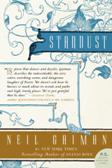 Yes. I realize that another of my favorite authors is releasing an important fantasy book on Friday at midnight. Yes, I am excited! Yes, I will read that book as well. Yes, I realize this is not that book. You see there is a slight problem. I lost out. I got to read Book Six first, so that means Whirl gets to read Book Seven first. So I needed to pick up something else– preferably something within the same genre.
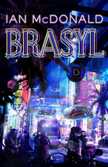 Ian McDonald has won a number of prestigious awards and nominations for his science fiction. Most recently these have included the British Science Fiction Association award and nominations for the Arthur C. Clarke Award and the British Fantasy Society award for his novel, River of Gods. River of Gods gives India a powerful postcyberpunk treatment. In McDonald’s 2047 India, we find genetically engineered children as a new caste. Adults are surgically transformed into a third, neutral, gender. The Ganges is running dry, sparking a water war.
 Bill Geist attended this year’s Printers Row Book Fair. He came as a guest author and signed copies of his new book, Way Off the Road. Whirl and I attended the book fair for two reasons. First reason, we had no choice. The fair sets up in our front yard. And it stays there for two days. If we want to go anywhere outside the building, we have to go through the fair. Second reason, they sell books at the book fair. I like books. Books are the one possession in our house that escapes the two-year rule. “If you haven’t used this in two years, you probably never are going to use it. It’s safe to get rid of it.”
 For years my friends have been trying to coerce me into reading something from Tim Powers. So I am. This is the editorial review: The colonization of Egypt by western European powers is the launch point for power plays and machinations. Steeping together in this time-warp stew are such characters as an unassuming Coleridge scholar, ancient gods, wizards, the Knights Templar, werewolves, and other quasi-mortals, all wrapped in the organizing fabric of Egyptian mythology. In the best of fantasy traditions, the reluctant heroes fight for survival against an evil that lurks beneath the surface of their everyday lives.
 In March of 1996, Outside magazine sent Jon Krakauer on an expedition to climb Mount Everest. Krakauer’s editors wanted him to write about the increasing commercialism of the summit. Krakauer stated he had given up mountain climbing long ago. He agreed to the climb for purely professional reasons. He later revised this statement, confessing a reawakened desire to climb mountains– like the heroes of his childhood once had done.
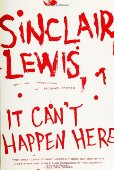 Sinclair Lewis was an American novelist and playwright. His novel, Main Street, was to be awarded the Pulitzer Prize in 1921. The Columbia University Board of Trustees overturned the jury’s decision. Five years later, Lewis again was awarded with the Pulitzer, this time for his novel Arrowsmith. Lewis refused. In 1930, Lewis became the first American author to win the Nobel Prize in Literature. Insightful and critical, satirical, and sympathetic– It Can’t Happen Here is Lewis’ last great work. This speculative novel warns that political movements akin to fascism can come to power in countries such as the United States when people blindly support their leaders.
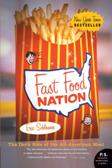 Eric Schlosser levels the following charges: fast food has hastened the malling of our landscape, widened the chasm between rich and poor, fueled an epidemic of obesity, and propelled American cultural imperialism abroad. That’s a bold statement. Schlosser first wrote about the unsanitary and discriminatory practices of the fast food industry in a two-part series for Rolling Stone magazine in 1999. He expanded that treatment into this almost 300 page book and published it in 2001.
 Beta|Erinyes