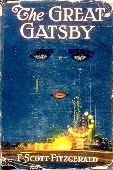
 It is not normal for me to reread a book. I read a book, I savor it as I do so. I pick the next book from my stack. A claim that Benjamin Franklin would read a linear foot of books a week inspires me. I have no idea whether that claim is true or not– a quick bit of research found nothing to corroborate it. But that is not the point. The point, as I see it, states that there are so many books worth reading that rereading one might just be a waste of time. So, as a general rule, I don’t do it. I don’t reread books.
And like most self-made rules, I’ve broken this one on a number of occasions. My latest reading selection, The Great Gatsby by F. Scott Fitzgerald, stands as my most recent transgression. I remember reading this book in seventh grade– twenty-five years ago. I remember the parties. I remember the suicide. I remember the classroom discussion about the elements that appeared to be autobiographical. Several years later I remember attending the one-woman play, Zelda, by William Luce.
In the summer of 1930, F. Scott’s wife and archetypical flapper, Zelda Fitzgerald, suffered a mental breakdown, was diagnosed with schizophrenia and was committed to a sanitarium. Luce’s play is set in a psychiatrist’s office in that sanitarium the night before Zelda died in a fire. She spent the last seventeen years of her life in that hospital. In Luce’s play, Zelda claims Scott placed her there not because she was crazy, but rather so that he could carry on his selfish, indulgent lifestyle without her interference. Zelda recalls how F. Scott Fitzgerald used their lives together as source material for his novels. She charges he stole her diaries: he included her private confessions in his own books. And she rejoins that her own novel, Save Me the Waltz, tells her side of their story– and displays her own talent.
Inspired by these works of art and psychology, I have, on occasion, introduced Whirl as my Zelda Fitzgerald. Given the treatment Zelda suffered, and the depiction in Luce’s play, my moniker may not seem particularly affectionate. I don’t mean it that way. I can be a melancholy boy. The conflict– even torment– of life and art fascinates me. Zelda Fitzgerald fascinates me in that I view her as personification of that conflict.
So twenty-five years later, I am returning to what is arguably the supreme achievement of F. Scott Fitzgerald’s career. To a time and place when the New York Times noted, “gin was the national drink and sex the national obsession.”
 In 2005, TIME magazine chose On the Road by Jack Kerouac as one of the 100 best English-language novels from 1923 to then. This largely autobiographical work is based on the spontaneous road trips of Kerouac and his friends across mid-century America. Many consider this book the definitive work of the postwar Beat Generation– inspired by jazz, poetry, and drugs. I have never read it. I picked it up on my last trip to the bookstore, shortly before my trip to Pittsburgh. In college I read Blue Highways by William Least Heat-Moon while backpacking through Europe. Before that I read John Steinbeck’s Travels With Charley on a family road trip. I like to read travel journals while traveling. This time I just got distracted by something shiny– namely a certain wizard.
 Chuck Klosterman has created a collection of previously published essays as Chuck Klosterman IV: A Decade of Curious People and Dangerous Ideas. The title is a tribute to Led Zeppelin’s untitled fourth album– commonly known as Led Zeppelin IV. He breaks the volume up into three sections: Things That Are True, Things That Might Be True, and Something That Isn’t True. Publishers Weekly describes his work, “Whether investigating Latino fans of British pop icon Morrissey, interviewing female tribute bands like Lez Zeppelin and AC/DShe or eating nothing but Chicken McNuggets for a week, Klosterman is always entertaining and often insightful.” My friend Smokes turned me on to Klosterman with Sex, Drugs and Cocoa Puffs. I liked most of that volume and I’ve been looking out for his name from time to time, now. I ran across a couple of his articles in Esquire magazine: “
 I have been anticipating the availability of this film on DVD since I first learned of it last year. The Bridge is a documentary film about suicide. Inspired by Tad Friend’s article “
 Monday afternoon I saw my sister safely to O’Hare for her flight back to Colorado. On the way back home I picked up the last book in the Harry Potter series by J.K. Rowling. As I mentioned earlier, I drew the second seating to read this one behind my child bride. The good news is that she finished the 759 pages of Harry Potter and the Deathly Hallows in less than two days. The bad news is: I’m up. Whirl is desperate for me to finish it so that we can talk about it.
 Yes. I realize that another of my favorite authors is releasing an important fantasy book on Friday at midnight. Yes, I am excited! Yes, I will read that book as well. Yes, I realize this is not that book. You see there is a slight problem. I lost out. I got to read Book Six first, so that means Whirl gets to read Book Seven first. So I needed to pick up something else– preferably something within the same genre.
 I find talk of climate change seemingly everywhere I look. Yesterday more than a 150 of the world’s most popular music acts contributed to the worldwide concert,
 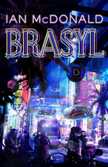 Ian McDonald has won a number of prestigious awards and nominations for his science fiction. Most recently these have included the British Science Fiction Association award and nominations for the Arthur C. Clarke Award and the British Fantasy Society award for his novel, River of Gods. River of Gods gives India a powerful postcyberpunk treatment. In McDonald’s 2047 India, we find genetically engineered children as a new caste. Adults are surgically transformed into a third, neutral, gender. The Ganges is running dry, sparking a water war.
 Beta|Erinyes