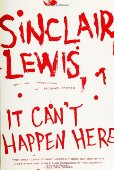
 Sinclair Lewis was an American novelist and playwright. His novel, Main Street, was to be awarded the Pulitzer Prize in 1921. The Columbia University Board of Trustees overturned the jury’s decision. Five years later, Lewis again was awarded with the Pulitzer, this time for his novel Arrowsmith. Lewis refused. In 1930, Lewis became the first American author to win the Nobel Prize in Literature. Insightful and critical, satirical, and sympathetic– It Can’t Happen Here is Lewis’ last great work. This speculative novel warns that political movements akin to fascism can come to power in countries such as the United States when people blindly support their leaders.
It has been misattributed to Lewis that he writes in this book, “When fascism comes to America, it will be wrapped in the flag and carrying a cross.” And while the particular quote was never written, the sentiment behind it permeates much of the language. New American Library recently reprinted this novel in 2005 and I picked it up as my next book in part due to the the power I perceive in the quote coupled with the impact of the recent documentaries, Jesus Camp and The Corporation, and the non-fiction books, State of Fear and Fast Food Nation.
Michael Meyer wrote a new introduction to the 2005 printing. He concludes his introduction with:
[Lewis] believed that dissent– even a cranky, erratic, eccentric, old-fashioned version of it– was not disloyalty but at the heart of an American democratic identity. Engulfed in the complexities and vulnerabilities of our post-September 11 world, Americans of nearly all political persuasions are likely to find that It Can’t Happen Here, though firmly anchored in the politics of the 1930s, surfaces as a revealing and disturbing read.
The book’s back cover reads:
It Can’t Happen Here is the only one of Sinclair Lewis’ later novels to match the power of Main Street, Babbitt, and Arrowsmith. A cautionary tale about the fragility of democracy, it is an alarming, eerily timeless look at how fascism could take hold in America. Written during the Great Depression, when the country was largely oblivious to Hitler’s aggression, it juxtaposes sharp political satire with the chillingly realistic rise of a President who becomes a dictator to save the nation from welfare cheats, rampant promiscuity, crime and a liberal press.
Sound familiar?
 Bill Geist attended this year’s Printers Row Book Fair. He came as a guest author and signed copies of his new book, Way Off the Road. Whirl and I attended the book fair for two reasons. First reason, we had no choice. The fair sets up in our front yard. And it stays there for two days. If we want to go anywhere outside the building, we have to go through the fair. Second reason, they sell books at the book fair. I like books. Books are the one possession in our house that escapes the two-year rule. “If you haven’t used this in two years, you probably never are going to use it. It’s safe to get rid of it.”
 For years my friends have been trying to coerce me into reading something from Tim Powers. So I am. This is the editorial review: The colonization of Egypt by western European powers is the launch point for power plays and machinations. Steeping together in this time-warp stew are such characters as an unassuming Coleridge scholar, ancient gods, wizards, the Knights Templar, werewolves, and other quasi-mortals, all wrapped in the organizing fabric of Egyptian mythology. In the best of fantasy traditions, the reluctant heroes fight for survival against an evil that lurks beneath the surface of their everyday lives.
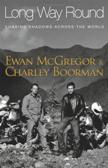 It’s spring of 2004. Ewan McGregor and Charley Boorman are trying to decide what to do with their summer. They come up with an incredible plan. Both are motorcycle enthusiasts and they want to do something unique. They decide to take the summer off and ride motorcycles around the world. They plan to start in London and end in New York City. And since they are planning something so singular, they decide to film it. Then they decide it would be better if someone filmed it for them. I imagine the initial conversation going something like this:
 In March of 1996, Outside magazine sent Jon Krakauer on an expedition to climb Mount Everest. Krakauer’s editors wanted him to write about the increasing commercialism of the summit. Krakauer stated he had given up mountain climbing long ago. He agreed to the climb for purely professional reasons. He later revised this statement, confessing a reawakened desire to climb mountains– like the heroes of his childhood once had done.
 I will never understand the rivalry that exists between the fans of Chicago’s two baseball teams. I think it is something that develops at birth. I was not born here. I did not grow up here. I missed out. I came to Chicago as an adult. Granted, a tabula rasa when it came to professional baseball– but I still missed out. I think it is too late for me.
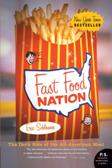 Eric Schlosser levels the following charges: fast food has hastened the malling of our landscape, widened the chasm between rich and poor, fueled an epidemic of obesity, and propelled American cultural imperialism abroad. That’s a bold statement. Schlosser first wrote about the unsanitary and discriminatory practices of the fast food industry in a two-part series for Rolling Stone magazine in 1999. He expanded that treatment into this almost 300 page book and published it in 2001.
 Sherman Alexie wrote The Lone Ranger and Tonto Fistfight in Heaven and The Toughest Indian in the World. He adapted parts of the first book into the screenplay for the 1998 feature film Smoke Signals. Flight is Alexie’s first novel in a decade. Using wit and eulogy, satire and sentimentality Alexie tells the story of an orphaned Indian boy who travels back and forth through time searching for his true identity. The book’s jacket states:
 Beta|Erinyes