This year’s project is inspired by the Ringling Brothers and Barnum & Bailey Circus. Spencer and Templar took their children to the circus this year when it came through Chicago and that served as the seed of the idea for our annual gingerbread project. We started with the traditional three rings and then contemplated how to include some vertical elements into the display: a high wire act, a big top, something up. After some consideration we decided that a tightrope extended across the rings might just work — if we could successfully build some sort of support. This year we did it.

Gingerbread Circus

For years, we have unsuccessfully attempted to build circular towers out of gingerbread. Gingerbread is not the strongest of building materials. Our attempts at circular towers have fallen upon a series of results filled with failure and despair. This year Spencer struck upon the idea of baking the towers around a paper towel roll protected by some parchment paper. We baked the towers for twice as long as we baked other elements of the construction, rotating them throughout the baking process and the cooling process to help them retain their shapes. The towers were a little uneven around the base, as the bases were not square. But it was nothing we could not correct with some shims made from candy and a healthy application of icing as mortar.

Purple Pony Tightrope WalkerWith that problem solved we were able to buttress the towers with gumdrops and icing to give them stability and began attacking the issue of the tightrope. Templar fashioned a rope out of Twizzlers and we managed to secure it to the towers once we added the platforms. We had the stage for our own high wire act so we went about designing the various acts.

None of our gingerbread creations have ever suffered for a lack of bizarre visualization and elements. This year was no different, and included more than a few references back to earlier gingerbread projects, particularly the year of the zoo. As a result, our gingerbread circus acts included some standards and some (shall we say) adaptations on a theme:

But the spotlight obviously was focussed on the tightrope. And we needed a tightrope walker. Danaan provided. Our tightrope walker was something you won’t see at that other circus when it comes through your town. No, our tightrope walker was a purple pony!

A purple pony! Top that, Cirque du Soleil.
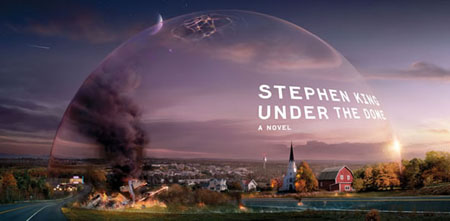
Whirl recommended the recent Stephen King novel to me, Under the Dome. As the book weighs in at just around twenty-five pounds, I’m somewhat concerned that she may be trying to throw my back out as I haul it around. — Okay, it doesn’t weigh twenty-five pounds, but this book is big. This book is heavy. There is no mistaking this for anything other than a book. A very big book.

The premise is simple: On an entirely normal fall day, a small town in Maine (of course) is suddenly and inexplicably sealed off from the rest of the world by an invisible force field. King gleefully, masterfully provides over a thousand pages to tell you what happens next.

In May, 2009, six months ahead of the publication of Under the Dome, Dan Simmons mentioned receiving the manuscript from King as a gift. Simmons’ reaction:

What’s amazing to me is that Under the Dome is the kind of huge, generous, sprawling, infinitely energetic novel that we (or at least I) associate with gifted young novelists in their 20’s—all energy and enthusiasm, the young author having not yet learned a long-distance novelist’s greedy trick of holding back characters or plot or techniques for future novels—and yet here with a master’s total control of the telling, myriad of characters, tone, and effects.

Do I have your attention now?

Wabash TypefaceSomewhere through the course of the Monon Bell Classic this afternoon I relaxed. In twenty-two years, I have never seen such a one-sided bell game. Not ever. Victory was sweet. Victory was very sweet. The bell game is always the last game of the regular season, and DePauw was coming to Crawfordsville with an undefeated record. They left, Tiger tails between their legs, battered and beaten.

DePauw 0 Wabash 47.

Wabash College’s Little Giants turned in one of the most dominating performances in the 117 years of the Monon Bell Classic Saturday, hammering previously unbeaten DePauw, 47-0.

The Monon Bell Classic may not mean much to you, but it means a great deal to me. This is my alma mater we’re talking about. And in the four years I was a student at Wabash, we won the bell only one of them: my senior year. This year was the 100th consecutive year the two teams have played.

I had planned on watching the game at home as it was being televised on HDNet. However, I failed to recall that in April our cable provider had dropped that channel for unexplained reasons. So I was left to scramble for a place to see it. Whirl and I were the only two at the Tilted Kilt interested in this game, but the place was kind enough to put it up on one of the big plasma TVs for us and kept us refreshed with an endless supply of Goose Island Matilda.

Howard Hewitt provides full coverage and stats of the game. Read that while I sing “Old Wabash” once more.

Printer's Row Helicopter Lift 1

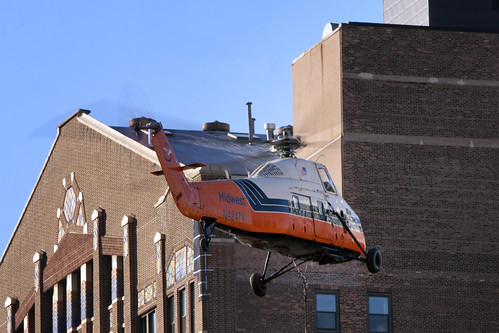
A week ago all the residents in Printer’s Row recieved notice of an extensive helicopter lift operation taking place in the neighborhood. Four new pieces of HVAC equipment were to be lifted to the roofs of the Printer’s Square towers on Federal Street and the old equipment lifted down and hauled away. While the rest of Chicago enjoyed an extra hour of sleep due to the end of daylight saving time, Printer’s Row had street closures and low-flying aircraft as our makeshift alarm clock.

I grabbed the camera and headed out into the chill morning to get some photographs. I’ve seen several helicopter lifts, but none ever this close. Some of the most memorable were the various lifts to place new antennas on the top of the Sears Tower several years back. As you might imagine, the lift attracted quite a bit of attention, and there were a number of amateur photographers out taking pictures — and then quite a few more people obliviously trying to make their way down Dearborn to get a cup of coffee. Chicago police were vigilant in keeping sleepy pedestrians out of harm’s way. The helicopter was flying as low as 100 feet above the street right next to the 22-story Transportation Building. Exciting stuff.

Unfortunately, the lift ended a little over halfway through the projected process. The final two pieces turned out to be too heavy for the helicopter and the task was cut short. Midwest Helicopter succeeded in raising two of the four HVAC pieces to the roof and lowering three of the old pieces down to the awaiting flatbed trucks.

Windy City Rollers vs. Oly Rollers 5
Last year I had the opportunity to shoot the Windy City Rollers All-Star squad shortly before they headed to the Declaration of Derby, the WFTDA National tournament in Philadelphia. And as much as I wanted to make some frames that would make Strazz weep with envy, I didn’t quite manage that. But I’m not one to just give up with one minor setback. They knock you down, you get right back up and try again. (Just so that it is said, I didn’t get knocked down. The girls did; I didn’t.)

When I learned that the Windy City Rollers would be hosts for this year’s WFTDA National tournament, Uproar On The Lakeshore, I applied for photo credentials. And got them! Although not for the entire tournament, I received a full-day press pass for the main day of action, Saturday. It was also the day the Windy City Rollers were guaranteed to compete. Being a single elimination tournament, teams only get one shot at moving on.

So, handy press pass in hand, I headed over to the UIC Pavilion yesterday morning and set about finding my way to the “digital darkroom”. This was serious business, this time around, with dozens of photographers from all over the nation covering the event. Team photographers, press photographers. The Derby News Network streamed all the action live online.

And then there was me jumping around trying not to get run over and trying to make some good shots at the same time. The whole style of the game has changed since last year. Last month, the Chicago Reader published an extensive feature about the advent of “slow derby” and its corresponding challenges to more traditional leagues like the Windy City Rollers. The tournament was a great opportunity to see these new styles in action.

Bout after bout the teams who best incorporated the strategies of the Western style came out on top, so I set as a goal for myself to try and capture some of the technique: the strategy of trading penalties, the massive walls of stopped blockers. And the ensuing frustration that played across more speed-and-power oriented teams.

I covered three bouts and stayed to watch the fourth and final bout of the day while editing what I’d shot:

Rocky Mountain Rollergirls vs. Charm City Roller Girls
Photos: 1, 2, 3, 4, 5, 6, Recap

Kansas City Roller Warriors vs. Philly Roller Girls
Photos: 1, 2, 3, 4, 5, 6, 7, 8, 9, 10, 11, 12, Recap

Windy City Rollers vs. Oly Rollers
Photos: 1, 2, 3, 4, 5, 6, 7, 8, 9, 10, 11, 12, 13, 14, Recap

Rocky Mountain Rollergirls vs. Gotham Girls Roller Derby
Recap

The latest novel from Douglas Coupland opens with a quote from Kurt Vonnegut. Coupland takes the quote from the commencement address Vonnegut gave to the 1994 graduating class at Syracuse University.

“Now you young twerps want a new name for your generation? Probably not, you just want jobs, right? Well, the media do us all such tremendous favors when they call you Generation X, right? Two clicks from the very end of the alphabet. I hereby declare you Generation A, as much at the beginning of a series of astonishing triumphs and failures as Adam and Eve were so long ago.”

Fifteen years later and Vonnegut was right. The name didn’t stick, but Vonnegut’s claims were spot on. All the claims about triumphs and failures have come true since 1994. Certainly the part about jobs was true. The less predictive elements about jobs are true again at the end of the first decade of the third millennium. A curious anecdote: most people I talk to directly attribute the title “Generation X” to Douglas Coupland and his first novel of the same name. Sure, Billy Idol’s punk band had the name fifteen before the novel, but it didn’t stick. No, it’s Generation X: Tales of an Accelerated Culture that fixed the label.

Coupland has checked in on his generation many times in the intervening years. Microserfs gives his vision of us working in the venture-capital driven days of the first dotcom boom of the early 90s. JPod chronicles the everyday lives of a group of six GenXers and Millennials working at a video game company in 2005. The protagonists are grouped together in a pod of cubicles, all their last names beginning with “J”. These short one- and two-sentence summaries do not do justice to the aptitude Coupland has with recognizing the pulse of time and culture on people. I want to use the adjective “uncanny” and then find myself consumed with uncomfortable laughter at the irony of that description. Coupland does that to me. There has not been a book of his that I have not thoroughly enjoyed. I cannot wait to read his latest.

From the back cover:

Generation A is set in the near future in a world where bees are extinct, until five unconnected people all around the world — in the United States, Canada, France, New Zealand, and Sri Lanka — are all stung. Their shared experience unites them in ways they never could have imagined.

Generation A mirrors Coupland’s debut novel, 1991’s Generation X. It explores new ways of storytelling in a digital world. Like much of Coupland’s writing, it occupies the perplexing hinterland between optimism about the future and everyday apocalyptic paranoia. imaginative, inventive, and fantastically entertaining, Generation A is his most ambitious work to date.

When I saw Chuck Klosterman last year he was promoting his novel Downtown Owl but his reading was from the as-yet unpublished collection of essays, Eating the Dinosaur. That was alright. I picked up the novel and waited for the collection to be published. Somewhere along the line I must have gotten distracted by shiny things and forgotten all about the other book. (I’ve noticed that happens to me a lot. The distractions and the shiny things, I mean.) So when I was at the bookstore the other day picking up Rework I noticed that not only had Eating the Dinosaur been published, but it was out in paperback as well. The dinosaurs followed me home.

Along with the essay I heard Klosterman read last year, “The Passion of the Garth”, a criticism of Garth Brooks’ alter ego project, Chris Gaines, Eating the Dinosaur contains twelve other previously unpublished essays about pop culture. And in typical style they run the entire spectrum from insightful to silly. That’s sort of the appeal for reading Klosterman. There is a criticism of laugh tracks in sitcoms, an analysis of time travel that pays particular attention to one of the most interesting science fiction films I’ve seen in a long time, Primer by Shane Carruth. Klosterman covers a huge selection of topics. He writes about basketball, Nirvana, the Unabomber and ABBA. There’s a piece titled, “The Best Response” that imagines what the best response would be to archetypical controversial situations, usually involving some sort of duplicity upon the adoring public.

And then there’s the first essay, “Something Instead of Nothing”. This exploration of the journalistic interview is conducted as a set of interweaving interviews itself, peppered with some reflection. After discussing the difficulties both journalists and subjects have in portraying the truth about anything through an interview, Klosterman spends some trying to discover an answer to the question: Why do it? Why succumb to interviews? The essay outlines several different answers to that question before moving on to what I think is the more interesting question. How does this apply to normal people? People who have no celebrity, the millions of unfamous. Chris Heath a British writer starts with an interesting answer that Klosterman picks up and carries to a telling conclusion:

Heath: We are used to the idea of giving witness to one’s life as an important and noble counterpoint to being unheard, especially when applied to people in certain disadvantaged, oppressed or unacceptable situations. […] I’m not sure that we aren’t seeing the emergence of a society in which almost everyone who isn’t famous considers themselves cruelly and unfairly unheard. [….] And so, the cruelly unheard millions are perpetually primed and fired up to answer any and all questions in order to redress this awful imbalance.
Klosterman: There’s a lot of truth in that last bit. Contemporary people are answering questions not because they’re flattered by the attention; they’re answering questions because they feel as though they deserved to be asked. About everything. Their opinions are special and so they are entitled to a public forum. Their voice is supposed to be heard, lest their life become empty.
This, in one paragraph, explains the rise of New Media.

Naturally, once I had read that exchange, I felt an overwhelming compulsion to write about it in my obscure little blog on the Internet. It was beyond my control.

Whirl had her birthday at the beginning of this month. Along with that particular event came “All The Unpleasantness” regarding gall stone attacks. So I wanted to do something fun for her for her birthday. While I was walking north up State Street one afternoon late last month, I noticed the name Ricky Gervais on the marquee of the Chicago Theater. He was planning three nights of stand-up in Chicago for the first time in his career. I said to myself, “Self, that sounds like a birthday present, it does.”

I stop by the box office, get my pick of seats, and in three minutes the deal is done. All without the obligation to contend with Ticketmaster “convenience” charges. (They keep using that word. I don’t think it means what they think it means.)

I first learned about Ricky Gervais nearly six years ago while working with Midway’s London office. The NBC television series “The Office” was set to premiere and my British colleagues were quick to disabuse me of the notion that this was original material. They quickly educated me about the original BBC version of the show and when later in 2005 while working in London and Newcastle I had an opportunity to catch a few episodes on borrowed DVDs. Whirl and I have watched all of the original BBC and the ongoing American versions of “The Office” series. We thoroughly enjoyed the short-lived HBO series “Extras” and his first standup tour recorded for HBO, “Out of England”. But we had never seen him perform live. He’d never come to Chicago to perform before last night.

Gervais’ show at the Chicago Theater was fantastic. I felt there was an air of authenticity to the show that broke through the perception of performance. And that’s not an easy task given the nature of the room. The Chicago Theater is an ornate space, one that reinforces with every turn and detail that the audience is here to be entertained. To see a show. But I never felt like Gervais was putting on a show. It just seemed like he was telling funny stories. Cringe-worthy, outrageously funny stories. Maybe it was because he occasionally broke up this structure to discuss the very nature of comedy, or to explain that there was a particular exclusivity to what we were seeing. After all, he was testing new material and would throw out the “shit bits” that didn’t work. We’d be the only ones to ever get to see that part of the act.

John Dugan posted an excellent review of last night’s show for Time Out Chicago. Chris Jones posted another for the Chicago Tribune.

They’re planning to film the performances tonight and tomorrow night. And when we spoke with the ushers before the show last night, the second two shows are nearly sold out. But if you get an opportunity to come down and see him, do. If you cannot, listen to the “Ricky Gervais Guide to The English” at The Guardian.

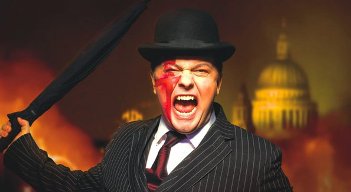
On photography note, the promotional art for the tour was shot by Dirk Rees in April 2009 for an article for Shortlist magazine. It was retouched by The Operators. The red cross on Gervais’ face is for St. George’s Day. I think it is a fantastic, inspirational portrait.

Rarely do I read business books. When I read something work-related, it is often technical: a manual, a white paper, a discussion of specific principles or process. Alternately I choose a more journalistic discussion of a catastrophic failure. The Moment It Clicks will serve as an example of the former; The Smartest Guys in the Room, the latter.
Rework by Jason Fried and David Heinemeier Hansson is something different for me. Superficially, this is the sort of book that attempts to explain how to be a successful businessman. The sort of books that pack the stores at airports. Certainly not my usual fare. But then, Rework is not filled with your usual advice. In fact, Freid and Hansson actively argue against the conventional wisdom of writing a business plan, studying the competition, and seeking outside investors in order to be successful. The eighty-eight included essays (each two or three pages in length) address simple maxims learned from ten years of sustained business success in a software development company, 37 Signals. These short essays have titles like: “Learning from mistakes is overrated”, “No time is no excuse”, “Focus on what won’t change”, and “You don’t create a culture”.

I first came across 37 Signals a few years ago when we began using their product, Basecamp, to manage projects and information regarding our building. More recently, as my colleagues and I were attempting to navigate the the volatility surrounding working for Tribune Company, Rework was one of the books that garnered my attention when Konkol discussed it at lunch. What Fried and Hansson reiterate is all that really needs to happen is to stop talking and start working. Much of the matieral was first introduced on the Signal vs. Noise blog — a fact they acknowledge in the book itself when discussing the value of production byproducts. Much like sawdust is a resalable byproduct of a lumber yard, the book is a byproduct of their own experiences running a successful business.

Jason Fried and David Hansson follow their own advice in REWORK, laying bare the surprising philosophies at the core of 37signals’ success and inspiring us to put them into practice. There’s no jargon or filler here just hundreds of brilliantly simple rules for success. Part entrepreneurial handbook for the twenty-first century, part manifesto for anyone wondering how work really works in the modern age, REWORK is required reading for anyone tired of business platitudes. — Chris Anderson

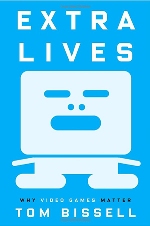
I learned about Tom Bissell and the publication of his book Extra Lives by listening to Michael Abbott and his “Brainy Gamer” podcast. In June’s episode, Abbott spent the majority of the episode interviewing Bissell about the idea of video game criticism in general and writing the book in specific. Since reading “The Lester Bangs of Video Games” by Chuck Klosterman in Esquire in 2006, I have quietly tried to see if any authentic voice has risen to the challenge. Have we finally found a voice that specializes in explaining what playing a given game feels like? Or provides meaningful analysis of what a game mean in a context outside of the game itself?

But to continue down an overly-long prelude about the book, I feel obligated to note that I am interested in Abbott for more than just his attempt to answer Klosterman — if that was Abbott was trying to do in the first place. No, what really captured my interest in Abbottis the fact that he is a Theater professor at my alma mater, Wabash College. In the Fall of 2008, Wabash Magazine published a profile on Abbott highlighting his Brainy Gamer work and the Center for Inquiry. In August of this year, Wabash posted the profile online. I suspect this may, in part, be in reaction to the Abbott’s inclusion of Portal as a text in his freshmen seminar. The blogosphere suffered a few minutes of apoplexy in response before being distracted by Halo: Reach. (Then again, the profile could also have been posted in anticipation of a second feature in the Fall 2010 edition of Wabash Magazine. Abbott is writing this second piece to discuss his experiences with Brainy Gamer. — Nah, it was about the press.)

Okay, now that I have digressed rather far afield, let me get back to the topic at hand, namely the book Extra Lives by Tom Bissell. Well, maybe not. I mean, I’ve given you enough leads to start your own discussion about the roles of video games in education, art, literature, entertainment, business and attention deficit disorder-derived hysteria. My work here is done. Besides, I’ve got a book to read.

Oscar Villalon writes in his review for NPR:

Parts memoir, criticism and reportage, freely mixing the high with the low, Extra Lives channels the author’s intimate history with games into something richer. At its simplest, the book charmingly informs us about the massive complexity and taxing labor entailed in producing a marquee title like Gears of War or Fable II. At its finest, Bissell’s book is a thrilling attempt at providing a critical framework for understanding and judging video games. [….] Lauding the medium’s great achievements and sharing his irritation with its longstanding flaw, Bissell makes a convincing case that video games are inching toward art, if not some mind-bending realm. Extra Lives, thanks to its insight and passion, may well end up providing one great push toward that end.